
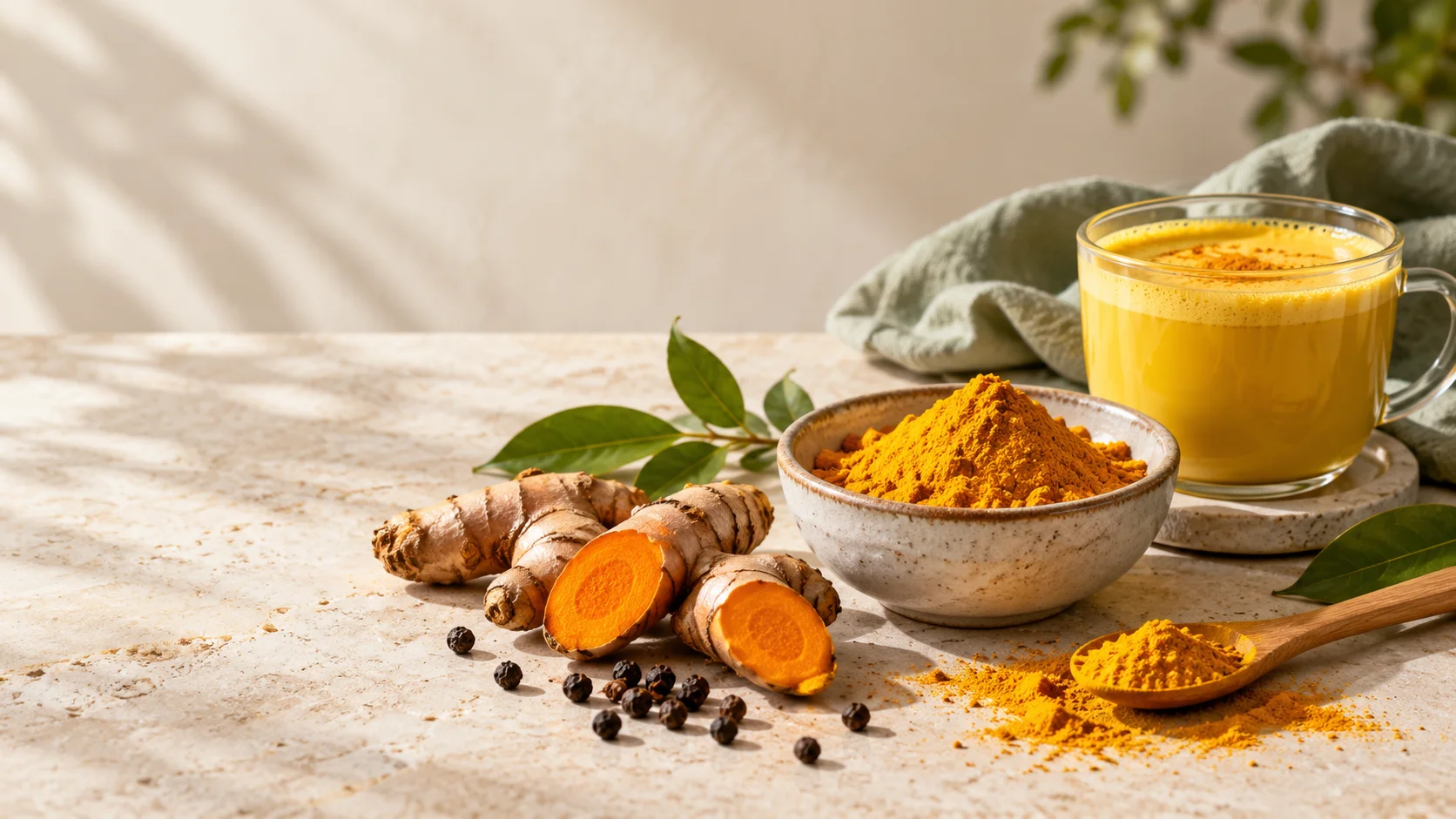
Turmeric is often presented as the ultimate natural anti-inflammatory. Do the studies say the same? You may have read that adding black pepper to this golden spice is all it takes to multiply its benefits. Yet there are several differences to understand between a curry recipe and a concentrated capsule.
The reality is more modest than its reputation. Research on turmeric and inflammation gives encouraging results in a few settings, notably for knee osteoarthritis pain. It doesn’t allow anyone to promise relief for everyone or to replace a treatment.[1]
Here’s what the studies really show, what black pepper changes, and how to use turmeric with realistic expectations.

Key Takeaways
- A spice and a concentrated extract are not the same.
- Evidence in humans is still limited.
- A knee result doesn’t apply to every condition.
- Read the curcuminoid content, not just the milligrams.
- More absorption doesn’t mean more benefit.
- In cooking, use it for flavour.
- On medication? Get advice before any supplement.
- Persistent pain? See a doctor.
Can turmeric really reduce inflammation?
Can a spice have biological effects? Turmeric contains several compounds that have been studied, including curcumin. Researchers assess their effects in the lab and in humans. But seeing a mechanism in cells is not enough to show a benefit for a person.
You need to look at clinical trials: which product was used, in whom, for how long and with what results? The answer is more precise than a blanket claim that turmeric is “good for all inflammation”.
What results are seen for joint pain?
Above all, you want to ease a painful knee? A trial published in 2020 compared a turmeric extract with a placebo:
The nuance matters: less pain does not prove that the joint has been repaired. This trial was small and short. It doesn’t show that every turmeric product will have the same effect.
Why don’t the results apply to every use?
Does a result in osteoarthritis also hold for tendinitis, a bowel disease or persistent fatigue? These situations are different, and each needs its own evidence.
The formulations studied also vary: amount of extract, curcuminoid content and absorption-enhancing processes. Health authorities stress that better-quality research is still needed before firm conclusions can be drawn about the claimed benefits.[1]
If your symptoms persist, have their cause investigated. Pain or tiredness alone doesn’t allow you to diagnose chronic inflammation yourself.
{{cta}}
What is the difference between turmeric, curcumin and extracts?
Ever hesitated in front of a label between “turmeric 500 mg” and “curcumin 500 mg”? These terms don’t necessarily mean the same thing.
The turmeric in your kitchen is therefore not as concentrated as an extract. Studies on one specific product can’t automatically be applied to another capsule or to a homemade drink.[1]
Why is turmeric paired with black pepper?
Why does this duo appear in so much advice? Black pepper contains piperine, which can increase how much curcumin becomes available in the body. This is called bioavailability: the share of a substance that becomes available after you consume it.
What does the often-quoted piperine study show?
Seen the “2,000%” figure? It comes mainly from a study published in 1998. Under the experimental conditions studied in volunteers, combining 2 g of curcumin with 20 mg of piperine increased curcumin’s bioavailability.[3]
That protocol is not a pinch of turmeric and a twist of the pepper mill. The amounts refer to specific isolated substances, not equivalent weights of kitchen spices.
The study measured absorption. It did not show that pain or inflammation fell in the same proportion. Nor are these figures a recipe to copy.
Does better absorption mean better results?
Is absorbing more always better? Higher absorption is not enough to prove a greater clinical benefit. It can also change the body’s exposure to the product and the risks that come with it.
So formulations can’t be compared on an absorption promise alone. Their clinical data and safety matter too. The French food safety agency, ANSES, has drawn attention to the risks of some turmeric supplements and of processes that increase its bioavailability.[4]
{{cluster}}
How much turmeric, and how do you read a label?
How much should you take to act on inflammation? There is no universal dose that applies to every product and every situation. The weight of powder, the amount of extract and the curcuminoid content are different pieces of information.
How much should you use in cooking?
Just want to flavour your meal? Use turmeric like any spice, in small amounts to suit your recipe and taste. A pinch in a soup or a lentil dish is enough to start.
This culinary guide is not a therapeutic dose. There’s no need to gradually increase the amount to reach a supposed “anti-inflammatory dose”.
Why aren’t milligrams enough to compare capsules?
Two boxes say 500 mg: do they provide the same thing? Not necessarily. First look at what is being measured, then at the daily dose. For example, 500 mg of an extract standardised to 95% curcuminoids works out at 475 mg of curcuminoids:
What are the side effects and drug interactions?
Can a plant supplement cause problems? Yes. Concentrated turmeric can cause digestive upset, and liver injury has been reported with some products.[1, 4]
ANSES highlights possible interactions with anticoagulants, cancer medicines and immunosuppressants, and advises against taking these supplements without medical advice in those situations. Bile duct disease also calls for particular caution.[4, 5]
These precautions mainly concern supplements and concentrated products. They don’t mean that ordinary use in cooking exposes you to the same doses.
How can you use turmeric in your meals?
A little turmeric can bring a different flavour to everyday dishes without making them harder to cook. A few ideas:
To build all your meals, see our guide to the anti-inflammatory diet and our list of anti-inflammatory foods. Turmeric can enrich your recipes; the variety on your plate is what matters most.
What about other supplements?
Does combining several ingredients necessarily bring more benefits? A combination needs its own evidence. Two substances studied separately are not enough to show that taking them together is worthwhile.
To find out about another product from the brand, you can discover AISA Moleculum Capsules, made with an orange-peel extract rich in d-limonene. This article does not show any synergy with turmeric and does not recommend combining them.
Sources
- NIH, NCCIH, “Turmeric: Usefulness and Safety”, updated April 2025. nccih.nih.gov
- Wang Z. et al., “Effectiveness of Curcuma longa Extract for the Treatment of Symptoms and Effusion-Synovitis of Knee Osteoarthritis: A Randomized Trial”, Annals of Internal Medicine, 2020. PMID 32926799
- Shoba G. et al., “Influence of piperine on the pharmacokinetics of curcumin in animals and human volunteers”, Planta Medica, 1998. PMID 9619120
- ANSES (French Agency for Food, Environmental and Occupational Health & Safety), opinion on the risks of food supplements containing turmeric, request 2019-SA-0111, 2022 (in French). anses.fr
- ANSES, opinion on the relevance of EMA monograph warnings for herbal food supplements, request 2019-SA-0155, 2022 (in French). anses.fr
You might be interested in this product
Anti-inflammatory capsules
«Inside-out» dietary supplement supports the integrity of the intestinal barrier and a balanced microbiome, helping to manage stress. 2 to 4 capsules daily on an empty stomach. Content corresponds to a take for 2–3 weeks. European clinical study on 138 healthy patients aged 65–85, for 45 days.

TARIF
€
120.00
A European clinical study involving 138 healthy patients (ages 65–85).


FAQ
Everything you need to know before placing an order: simple and clear.
Can you take turmeric every day?
Using it as a seasoning and taking a concentrated supplement are two different things. In cooking, use it to taste. Taking a supplement daily should be considered in light of its composition, your situation and your treatments: a long course is not automatically justified.[1, 4]
How long does turmeric take to work?
No timeframe can be guaranteed. The knee trial described here assessed results over twelve weeks; that doesn’t mean everyone should take a twelve-week course. Discuss goals and follow-up with a professional.[2]
Can turmeric replace an anti-inflammatory drug?
No. Don’t change a prescribed treatment without your doctor’s advice. The available results don’t support a general equivalence between turmeric and anti-inflammatory medicines.
Do you have to add black pepper?
No. Like your recipe without pepper? Keep it that way. The piperine results apply to specific conditions; they don’t create a cooking rule or a home dose that guarantees a benefit.[3]
Is fresh turmeric more effective than powder?
Choose according to your recipe and preferences. The trials cited used extracts and don’t allow fresh root and powder to be ranked by effectiveness. Neither becomes a treatment simply because of its form.
Latest posts
Did you enjoy this latest article? If so, you might be interested in this selection.




Ready to slow down the aging process?
Sign up for our newsletter and join the thousands of people who follow us to regain energy, vitality, and well-being.

Your cart summary
Product Name
$0
$0
-
Thank you! Your submission has been received!
Oops! Something went wrong while submitting the form.
+
Success message won't be visible to user. Coupon title will be listed below if it's valid.
Coupon1
Coupon2
Success message won't be visible to user.
Error message won't be visible to user.