
Have you noticed resveratrol being linked again and again to antioxidants and longevity? You may be wondering whether it deserves a place in your routine, beyond the claims on the label.
Human research offers some interesting but narrow results. Some effects concern metabolic markers in specific groups of people. They do not show that a supplement will help you live longer or protect everyone against disease.[1, 2]
To see things clearly, let’s look at what studies actually measure, where resveratrol is found and what to check before taking it.

Key Takeaways
- Tell apart mechanism, marker and clinical benefit.
- Check who was studied before applying the results to yourself.
- Eat a variety of foods, without trying to reach a supplement dose through your meals.
- Don’t drink for resveratrol: alcohol keeps all its risks.
- Have any supplement checked, especially alongside your medicines.
- Keep some distance from longevity claims: no extra years of life are shown here.
What do we really know about its benefits in humans?
Can an ingredient be promising without being a universal solution? Yes, and resveratrol is a good example.
An umbrella review published in April 2026 brought together 45 systematic reviews of studies on supplementation. It reports favourable effects on some measures, with varying certainty depending on the outcome. Among the findings the authors rated most robust were improvements in blood pressure in people with type 2 diabetes and in total cholesterol in adults with overweight.[1]
This is not a recommendation for every healthy person. Who was studied, the dose, the duration and the outcome measured all matter.
Keep three different levels in mind: a biological mechanism, a change in a marker in a study, and a proven benefit to your health. Getting from the first to the last takes further evidence.
What is this molecule found in some plants?
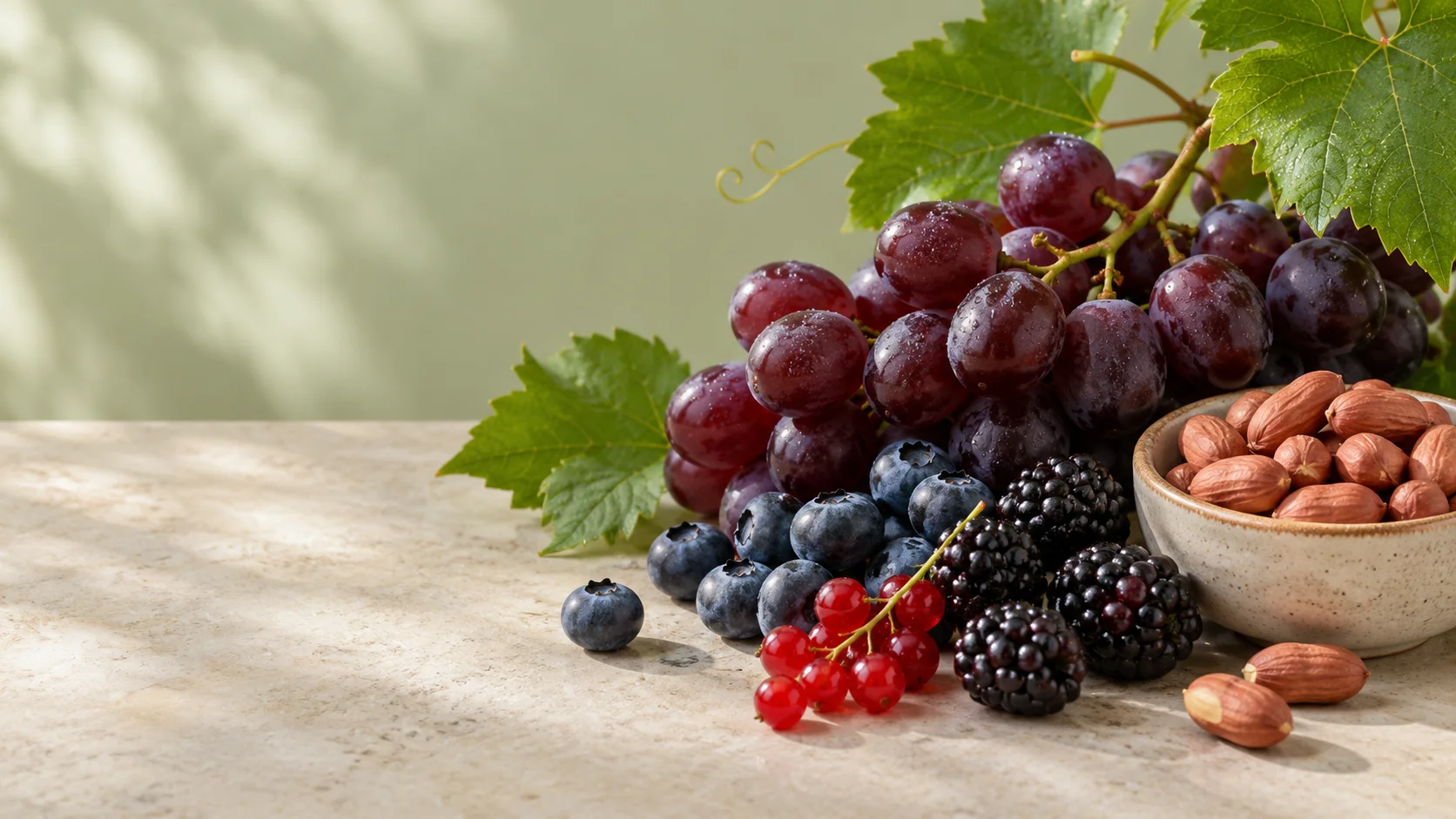
Why do grapes come up so often when people talk about resveratrol? Because this molecule belongs to the polyphenols found in some plants, including grapes.
Plants can produce it in response to stress, such as infection or ultraviolet light. It exists in several forms, including trans-resveratrol.[3, 4]
Its biological properties have prompted a great deal of research into the mechanisms of oxidative stress and inflammation. But your body is not a test tube: the molecule is absorbed, transformed and eliminated. Concentrations used in the lab do not automatically match those reached through food or a capsule.
Our article on glutathione and its antioxidant role explores another side of the body’s defences, without reducing how they work to a single ingredient.
Can it affect metabolism and inflammation?
Looking for a simple answer about blood sugar or inflammatory markers? The results need to be put in context.
A small 2011 trial studied 11 men with obesity for 30 days, at 150 mg a day. It reported favourable changes in some metabolic measures. By contrast, a 2012 trial using 75 mg a day for 12 weeks in postmenopausal women without obesity and with normal glucose tolerance found no metabolic improvement.[5, 6]
These older trials show why one result does not carry over to every profile. The 2026 umbrella review gives a broader view, while its conclusions remain specific to the populations and outcomes examined.
For inflammation, a meta-analysis published online in January 2025 covers six trials and 533 people with type 2 diabetes. It looks at markers of inflammation and oxidative stress. These data do not prove that a supplement will relieve any pain or treat any inflammatory disease.[7]
A change in a blood test does not, on its own, show fewer complications, hospital admissions or deaths.
{{cluster}}
Can it slow ageing or extend life?
Could a capsule add years to your life? The sources reviewed do not support promising this effect in humans.
Resveratrol is studied in the biology of ageing, but results from experimental models are not the same as proof of longer life in humans.
An observational study of 783 older adults followed for nine years in Italy found no association between dietary resveratrol exposure, measured through its metabolites in urine, and longer life.[2]
This study did not test high-dose supplementation, so it does not settle every question. Above all, it shows that the presence of this molecule in the diet cannot be turned into a guarantee of a longer life.
Our article on telomeres and longevity looks more closely at the difference between a biological marker and an outcome that matters to you.
Which foods contain resveratrol?
Do you need to hunt for a rare food? Several everyday foods contain resveratrol, in varying amounts.[3]
The amount varies, in particular with the plant and how it was grown. It would be misleading to promise the same dose in every bunch.
Choose these foods for their place in a varied diet. You do not need to eat large amounts of them to “reach” a dose used in experiments.
Do you need to drink red wine to benefit?
Would the famous glass of red wine be a good health strategy? The presence of resveratrol does not cancel out the risks of alcohol.
The NHS points out that there is no safe drinking level, and the World Health Organization says that no level of alcohol consumption is safe for health. Do not start drinking, or drink more, to get this molecule.[8]
You can eat grapes and other plant foods without having an alcoholic drink. A supplement does not reproduce all the features of a food either.
Why does bioavailability matter?
Does the amount you swallow match the amount that reaches your tissues in its original form? Not necessarily.
A human pharmacokinetic study showed that resveratrol could be absorbed while having low bioavailability in its unchanged form, because the body quickly transforms it into metabolites.[9]
This makes it harder to compare an experiment on cells, intake from food and a supplement. A small amount of unchanged molecule does not automatically mean there is no effect at all.[9]
Conversely, a formula marketed as “better absorbed” does not necessarily deliver a greater health benefit. That requires clinical results for that formula, on a relevant outcome.
What dose, and what precautions should you take?
Would a higher dose necessarily work better? That logic does not apply to supplements.
In its 2016 opinion, EFSA assessed a specific synthetic trans-resveratrol intended for adults. It concluded that 150 mg a day did not raise safety concerns under the proposed conditions. In Great Britain, it is authorised in capsule or tablet supplements for adults, up to 150 mg a day, with a label stating that people using medicines should only take it under medical supervision. This figure is not a recommended therapeutic dose, nor a guarantee for every formula.[4]
Digestive problems have been reported at high doses. Drug interactions are also possible: a study in volunteers taking 1 g a day for four weeks observed changes in enzymes involved in breaking down medicines.[3]
Before taking a supplement, show the product to your GP or pharmacist, especially if you take any medicine. If you are pregnant or breastfeeding, or for a child, do not apply data from adults to your situation.
How should you read supplement claims?
Looking at a label that promises “antioxidant”, “longevity” and “high absorption”? Ask a few concrete questions.
This approach helps you judge a claim without needing to know every scientific term.
For AISA moleculum capsules, check the ingredients and product information. The research presented here does not show a clinical synergy between resveratrol and the d-limonene in this product. A combination of ingredients needs its own evidence. AISA moleculum capsules do not contain resveratrol.
{{cta}}
What place should it have in your daily life?
Why not start by asking yourself which benefit you are looking for? Concern about your blood sugar, tiredness or a wish to age well do not call for exactly the same answer.
Keep your diet varied and choose habits that fit your life. If you have a health condition or take a treatment, talk to the professional who looks after you before adding a supplement.
Resveratrol remains an interesting research topic. You can learn about it without buying a product. And if you are considering one, look for a clear goal, suitable evidence and safety checked for your situation.
Read next
- Oxidative Stress and Free Radicals: What They Are and What Helps
- Telomeres and Longevity: What the Science Says
Source
Sources checked on 18 November 2026. Older studies illustrate how mixed the results are; the recent umbrella review is not used to promise a universal benefit.
- Sun et al., Nutrition Journal, “Effects of resveratrol supplementation on multiple health outcomes”, 15 April 2026. Umbrella review of 45 reviews, searches up to 30 April 2025; abstract read. Findings limited to the populations and outcomes examined. pubmed.ncbi.nlm.nih.gov
- Semba et al., JAMA Internal Medicine, “Resveratrol levels and all-cause mortality in older community-dwelling adults”, 2014. InCHIANTI study: 783 adults aged 65 and over, followed for nine years in Chianti; no significant association between urinary resveratrol metabolites and mortality. pmc.ncbi.nlm.nih.gov
- Chow et al., Cancer Prevention Research, “Resveratrol Modulates Drug and Carcinogen Metabolizing Enzymes”, 2010. Dietary sources and an enzyme interaction study at 1 g a day; the size of the effects should not be extrapolated to every dose. pmc.ncbi.nlm.nih.gov
- EFSA, “Safety of synthetic trans-resveratrol”, scientific opinion, EFSA Journal, 2016: safety assessment of a specific preparation, not an assessment of efficacy or a therapeutic recommendation; opinion not directly accessible on 18 November 2026. Food Standards Agency, register of authorised novel foods, “Trans-resveratrol” (NOVEL-138), updated 1 April 2025: authorised in England, Scotland and Wales in food supplements for adults (capsule or tablet), 150 mg/day, with a statement for people using medicines. Commission Implementing Decision (EU) 2016/1190 of 19 July 2016. efsa.europa.eu · data.food.gov.uk · legislation.gov.uk
- Timmers et al., Cell Metabolism, “Calorie restriction-like effects of 30 days of resveratrol supplementation on energy metabolism and metabolic profile in obese humans”, 2011. Indexed abstract read. pubmed.ncbi.nlm.nih.gov
- Yoshino et al., Cell Metabolism, “Resveratrol supplementation does not improve metabolic function in nonobese women”, 2012. Abstract and full text identified. pubmed.ncbi.nlm.nih.gov · pmc.ncbi.nlm.nih.gov
- Zhu et al., Frontiers in Endocrinology, “The efficacy of resveratrol supplementation on inflammation and oxidative stress in type-2 diabetes mellitus patients: randomized double-blind placebo meta-analysis”, volume 15 (2024), published online 13 January 2025. Type 2 diabetes: six trials, 533 participants; scope limited to the markers and population studied, no claim about pain. pubmed.ncbi.nlm.nih.gov
- NHS, “The risks of drinking too much”, reviewed 10 September 2026: “low risk” rather than “safe” because there is no safe drinking level. WHO Regional Office for Europe, “No level of alcohol consumption is safe for our health”, 4 January 2023. General position on risks; no calculation of how much wine would reach a dose. nhs.uk · who.int
- Walle et al., Drug Metabolism and Disposition, “High absorption but very low bioavailability of oral resveratrol in humans”, 2004. Human pharmacokinetic study; mechanism kept separate from clinical effectiveness. pubmed.ncbi.nlm.nih.gov
You might be interested in this product
Anti-inflammatory capsules
«Inside-out» dietary supplement supports the integrity of the intestinal barrier and a balanced microbiome, helping to manage stress. 2 to 4 capsules daily on an empty stomach. Content corresponds to a take for 2–3 weeks. European clinical study on 138 healthy patients aged 65–85, for 45 days.

TARIF
€
120.00
A European clinical study involving 138 healthy patients (ages 65–85).

FAQ
Everything you need to know before placing an order: simple and clear.
Is trans-resveratrol different from resveratrol?
Does the prefix “trans” mean a different ingredient? It refers to one form of the molecule. Seeing it on a label is not enough to show that the product works.[4]
Can resveratrol replace a medicine?
Does a positive result in a study mean you can stop a treatment? No. Do not stop a medicine to take a supplement. Ask your GP or pharmacist to check for interactions and whether the product is right for you.[3, 4]
Do foods provide as much resveratrol as a capsule?
Can a portion of grapes be compared directly with a concentrated dose? Intakes from food are generally much lower and more variable. Supplement studies do not show that foods have the same effect.[3]
Is there an ideal length for a course of resveratrol?
Can a standard course of a few weeks be recommended for everyone? Studies have different durations and aims. The sources reviewed do not support a standard programme for every healthy adult.
Latest posts
Did you enjoy this latest article? If so, you might be interested in this selection.


Ready to slow down the aging process?
Sign up for our newsletter and join the thousands of people who follow us to regain energy, vitality, and well-being.

Your cart summary
Product Name
$0
$0
-
Thank you! Your submission has been received!
Oops! Something went wrong while submitting the form.
+
Success message won't be visible to user. Coupon title will be listed below if it's valid.
Coupon1
Coupon2
Success message won't be visible to user.
Error message won't be visible to user.