
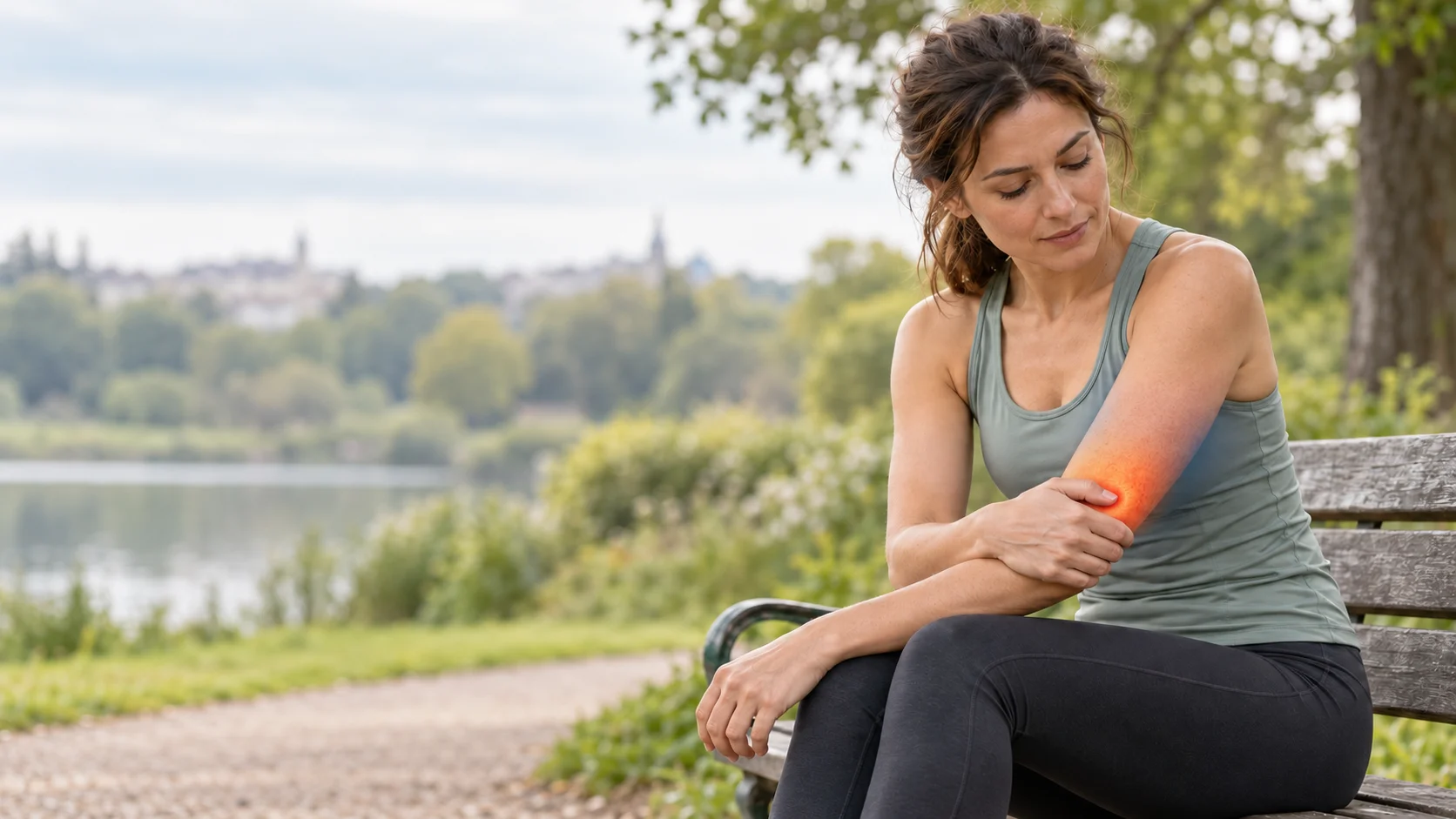
Does your neck feel stiff after a day at the screen? Or does a calf muscle suddenly tighten during a walk? When a muscle hurts, it is understandable to want a quick solution.
The right approach depends on what is causing the pain. For some neck pain, a hot or cold pack may give short-term relief. Stretching and massaging the muscle may ease the pain of a cramp. A recent strain calls for other precautions. No single natural muscle relaxant suits all of these situations.[1, 3, 4]
Here are some pointers to help you choose, without forcing a painful muscle or expecting more from a supplement than the evidence allows.

Key Takeaways
- Identify the context: tension, cramp or suspected strain.
- Use heat or cold carefully and protect your skin.
- Move gently without forcing a painful movement.
- Choose a comfortable massage, except after a recent injury or if there is a warning sign.
- Check before taking supplements, without assuming that a cramp means a deficiency.
- See a doctor if the pain persists, changes or comes with other symptoms.
Which approach suits your muscle pain?
Not sure where to start? First, look at the context: pain that builds gradually or comes on suddenly, unusual effort, a knock, swelling, difficulty moving.
These pointers guide your first steps. They are not a diagnosis. If you are unsure whether it is simple tension or an injury, a healthcare professional can help you decide.[1, 2, 3, 4]
How can you tell tension, a cramp and a strain apart?
Do you call any muscle pain a "knot"? The word can describe a muscle that feels hard or tight, without explaining why.
A cramp is a painful tightening of a muscle. Many people get cramps at night or when resting, and most go away without you doing anything. Cramps that last longer than 10 minutes, keep coming back, or come with numbness or swelling need checking.[1, 2]
A strain is an overstretched or torn muscle, also called a pulled muscle. The injured area may be swollen or bruised, and you may not be able to use it normally. Stop any exercise or activity. See a GP if it is getting worse or not improving after treating it yourself. Get urgent advice (in the UK, call NHS 111) if the pain is severe or getting worse, if there is a lot of swelling or bruising, or if you cannot put any weight on it or walk more than a few steps.[3]
Pain near a joint can also involve a tendon. Our article on tendonitis and how it is treated covers this situation.
If the pain started after an unusual workout, our articles on muscle soreness and myalgia, and on myalgia, will look at the causes and recovery in more detail. The word "myalgia" simply means muscle pain; it does not tell you the cause.
{{cluster}}
Can heat or cold ease the pain?
Does a warm shower seem to loosen your neck? For neck pain, a hot or cold pack can provide short-term pain relief, alongside gentle movement. Never put it directly on bare skin, and use it for up to 15 minutes at a time.[4]
Check your skin and stop if it becomes irritated or your symptoms get worse. Do not fall asleep with a heat source.
A recent injury changes what to do. For a suspected strain, you can use a bag of frozen vegetables wrapped in a tea towel for up to 20 minutes. NHS advice is to avoid heat, such as hot baths and heat packs, and massage for the first couple of days after a sprain or strain.[3]
Feeling better does not mean the muscle has healed. Use heat or cold as a comfort measure, then check how well you can move.
How can you use movement and stretching without forcing it?
Should you pull harder on a muscle to "release" it? Pain is not a signal to push through.
For common neck pain, start by changing your position and posture regularly and doing gentle movements within a comfortable range. Your GP may ask you to try this advice and these exercises before you see a physiotherapist. The exercises should not cause severe pain or make your neck pain worse.[4]
For a calf cramp, stretching and massaging the muscle may ease the pain. Regular calf-stretching exercises may help to reduce cramps, but may not stop them completely.[1, 2] Stretch gently, without jerking, and stop if the pain feels unusual or suggests an injury.
Stretching does not help equally in every situation. A 2025 meta-analysis of 15 studies and 465 participants found that stretching after exercise, compared with no stretching, did not significantly reduce muscle soreness. This does not prove that stretching is useless for every goal, but it limits any promise of faster recovery.[5]
Does a massage have to hurt to work?
Have you heard "no pain, no gain"? Pain is not a measure of how well a massage works.
Massage may help with neck or shoulder pain, but the benefits may only last a short time. Results vary, and studies do not allow anyone to promise the same effect for everyone.[6]
For everyday tension, gentle pressure may feel better than firm, insistent pressure. If you use a foam roller or a ball, do not try to crush the painful area. Stop if your symptoms get worse.
Avoid massaging a recent injury, or a swollen calf when the cause is unknown. Get medical advice first. Serious side effects are rare; some reported cases involved vigorous types of massage or people at higher risk of injury, such as older people.[3, 6]
If the pain keeps coming back, a comfort massage can be part of your care, but it does not replace finding the cause.
Is magnesium an effective muscle relaxant for everyone?
Do cramps always mean you are low in magnesium? No. Cramps alone do not show that you have a deficiency.
A Cochrane review published in 2020 concluded that magnesium supplements are unlikely to provide clinically meaningful cramp prevention in older adults. Evidence in pregnancy is conflicting. The review found no trials of magnesium for exercise-associated muscle cramps.[7]
Correcting a diagnosed deficiency is different from taking a supplement for any muscle tension. Magnesium supplements can also cause side effects, mainly diarrhoea and nausea.[7]
If your cramps keep coming back, contact your GP.[2] You can also talk to your GP or pharmacist about your diet, your medicines and the context. A tablet chosen at random may not address the problem.
What about herbs, essential oils and supplements?
Is a product of natural origin automatically right for your muscles? The word "natural" tells you where something comes from, not whether it works or is free of risk.
Essential oils are concentrated preparations. Many plants contain substances that are toxic or irritating, or likely to cause allergic reactions when applied to the skin, and some citrus oils can be harmful on skin exposed to the sun.[8] How they are used and the precautions to take vary from one product to another. Do not apply them at random, and do not swallow an essential oil unless a healthcare professional has told you to. Tea tree oil, for example, should not be swallowed.[9] Ask for advice and follow the instructions on the label.
For any herb or supplement, ask three questions: has the product been studied in humans, for which type of pain, and with what measured benefit? An effect seen in the laboratory does not show that a product will relax your muscle.
If you are considering AISA moleculum capsules, read the product information and check with a professional that they suit your situation and any medicines you take. The sources used for this article do not show that they work as a muscle relaxant. Mentioning them here does not replace appropriate care.
{{cta}}
How can you build a realistic relaxation routine?
Imagine you only notice your neck is tight when you close your laptop. You could start by noting when the discomfort appears.
A simple routine might include:
- Change position regularly, rather than staying still for a long time.
- Take a gentle movement break, at a level that feels comfortable.
- Temporarily cut back on the activity that triggers the pain, then discuss a gradual return if needed.
- Note what helps, so you can mention it if the discomfort persists.
These suggestions help you organise your day; they are not a one-size-fits-all programme. For neck pain, changing position and posture regularly and doing suitable exercises are part of the advice given by physiotherapy services.[4]
Keep to regular meals. Drink plenty of fluids while exercising.[2] Not drinking enough fluids is one possible cause of cramps among others, so drinking more will not fix every cramp.[1] If you have been told to limit how much you drink, follow the advice you were given.
A useful routine should help you get back to your activities, not make you go through a series of painful movements.
When should you see a doctor about muscle pain?
Does the pain feel different from your usual tension? Get it checked rather than masking it.
Read next
- Osteoarthritis Diet: Which Nutritional Approach Really Helps?
- Persistent Pain: What Natural Solutions Can Relieve Muscles, Joints, and Nerves?
Source
Sources accessed on 17 November 2026. Recommendations are used within their scope; findings on cramps are not extended to all muscle pain.
- NHS, “Leg cramps”, last reviewed 1 December 2023. Stretching and massage during a cramp, possible causes (including not drinking enough fluids and some medicines), when to see a GP. nhs.uk
- MedlinePlus (US National Library of Medicine), “Muscle cramps”, reviewed 22 July 2026. Stopping the activity, stretching and massage, fluids during exercise, when to contact a healthcare provider. medlineplus.gov
- NHS, “Sprains and strains”, last reviewed 23 April 2024. Symptoms, first steps after an injury, what to avoid in the first days, when to get urgent help; see also the Dudley Group NHS patient leaflet. nhs.uk · dgft.nhs.uk
- Dynamic Health, NHS physiotherapy service, “Neck pain”. Advice limited to the neck pain it covers: position, movement, hot and cold packs, warning signs. dynamichealth.nhs.uk
- Zhang et al., Frontiers in Physiology, “Effects of post-exercise stretching versus no stretching on lower limb muscle recovery and performance”, 2025 (DOI 10.3389/fphys.2025.1674871). Meta-analysis of 15 studies and 465 participants, literature searched up to 20 July 2025. No significant difference in muscle soreness; findings limited to the conditions studied. pubmed.ncbi.nlm.nih.gov
- NCCIH / NIH, “Massage Therapy: What You Need To Know”, updated May 2019. Variable, often short-term benefits, and risks; several of the studies summarised are older. No universal benefit is drawn from this page. nccih.nih.gov
- Garrison et al., Cochrane, “Magnesium for muscle cramps”, 2020. Searched up to September 2019; conclusions presented as those of this review, without claiming to cover trials published since. cochrane.org
- US Food and Drug Administration (FDA), “Aromatherapy”, content current as of 08/09/2023. Plant materials that can be toxic, irritating or cause allergic reactions on the skin; citrus oils on sun-exposed skin. fda.gov
- NCCIH / NIH, “Tea Tree Oil: Usefulness and Safety”, updated April 2025. Applies to tea tree oil only: should not be swallowed; possible skin redness or irritation. nccih.nih.gov
- CDC / NIOSH, “Signs and Symptoms of Rhabdomyolysis”, 28 October 2026. Unusual muscle pain, weakness, dark urine and the need for prompt medical attention. cdc.gov
You might be interested in this product
Anti-inflammatory capsules
«Inside-out» dietary supplement supports the integrity of the intestinal barrier and a balanced microbiome, helping to manage stress. 2 to 4 capsules daily on an empty stomach. Content corresponds to a take for 2–3 weeks. European clinical study on 138 healthy patients aged 65–85, for 45 days.

TARIF
€
120.00
A European clinical study involving 138 healthy patients (ages 65–85).

FAQ
Everything you need to know before placing an order: simple and clear.
What is the best natural muscle relaxant?
Is there one winner for every kind of pain? No. The choice depends on the cause: gentle movement for some neck pain, stretching and massage for a cramp, and for a suspected strain, a wrapped cold pack with no heat or massage at first, and medical advice if it is severe or not improving.[1, 3, 4]
Can you massage a tight muscle after sport?
Did the pain come on gradually or suddenly? Massage may give short-term relief in some situations. If you suspect a recent strain, avoid massage for the first couple of days and see a GP if it gets worse or does not improve.[3, 6]
Should you stretch to prevent muscle soreness?
Does stretching after exercise guarantee recovery without soreness? No. The 2025 meta-analysis we consulted found no significant reduction in muscle soreness. Do not force a sore muscle in the hope of recovering faster.[5]
Is drinking more water enough to stop cramps?
Does water fix every cramp? Drinking plenty of fluids while exercising matters, but not drinking enough is only one possible cause of cramps. If they keep coming back despite your changes, get advice rather than simply drinking more.[1, 2]
How long does it take to feel better?
Can anyone promise an exact timeframe? No. Most cramps go away without you doing anything, while a strain needs different care and recovery. Pain that gets worse or limits your activities should be checked again.[1, 3]
Latest posts
Did you enjoy this latest article? If so, you might be interested in this selection.


Ready to slow down the aging process?
Sign up for our newsletter and join the thousands of people who follow us to regain energy, vitality, and well-being.

Your cart summary
Product Name
$0
$0
-
Thank you! Your submission has been received!
Oops! Something went wrong while submitting the form.
+
Success message won't be visible to user. Coupon title will be listed below if it's valid.
Coupon1
Coupon2
Success message won't be visible to user.
Error message won't be visible to user.