
Silent inflammation
You can't see it. You can't feel it. But it's there, wearing you down, making you age, and affecting your mood. Here's what you need to know.
What is inflammation?
Inflammation is your body’s natural response to an injury (such as a cut, infection, or accident). Cut your finger ? Your body sends white blood cells to clean the wound. Catch a cold? Your immune system kicks into gear. It’s a natural process.
The problem arises when this inflammation does not subside after the resolution phase.

Acute inflammation vs. chronic inflammation
Acute inflammation is the kind you're familiar with: a swollen finger, a sore throat, a sprained ankle. It comes on quickly, does its job, and then goes away. It's your ally.
Chronic inflammation is the exact opposite. It’s subtle and invisible. There’s no obvious pain, no visible swelling, and no fever or redness. But it’s always there, quietly lurking in the background. And that’s what makes it so problematic.
Why is it called «silent»?
Because it doesn’t hurt. You don’t wake up with a fever. But you can still recognize it through other signs:
- Chronic fatigue: you sleep 8 hours but feel exhausted upon waking
- Dull skin and wrinkles: your skin loses its radiance and ages faster
- Mood swings: irritability, low motivation, low mood
- Weight gain that’s hard to lose: especially around the abdomen
- Diffuse joint pain: not a real injury, just subtle but persistent tension
- Unpredictable digestion: bloating, intestinal discomfort, even irritable bowel
If you check several of these boxes, there is a strong chance you have chronic inflammation.
Where does it come from?
Several factors contribute to and perpetuate chronic inflammation:
1. Social stress (an underrecognized factor)
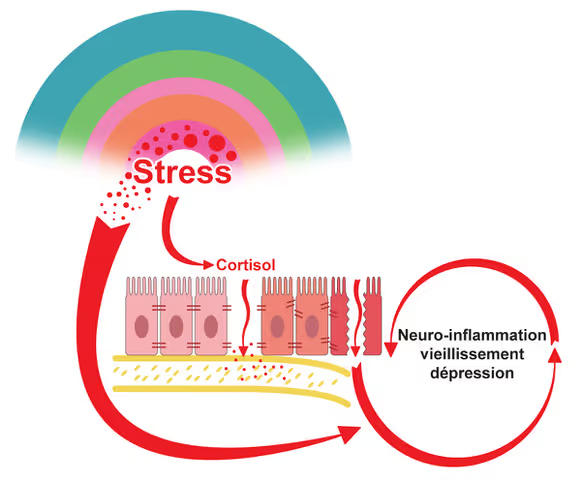
When you are stressed because of your social environment (work, family, relationships with others...), your body produces cortisol. A small amount of cortisol is physiological and anti-inflammatory. However, too much cortisol over time triggers inflammation by disrupting the intestinal barrier. A leaky gut allows inflammation to spread throughout the body, leading to neuroinflammation, which is at the root of many neurological symptoms (chronic fatigue, depression, anxiety, obsessive thoughts, lack of motivation, difficulty in concentrating, and social withdrawal).
And the more inflamed you are, the more stressed you become. It’s a vicious cycle.
2. Processed food
Too much sugar, too many trans fats, too many ultra-processed foods. Your gut doesn’t like it. It becomes permeable, allowing toxins to pass into your bloodstream. Your immune system becomes over-reactive, and inflammation in the gut becomes widespread.
3. Lack of sleep
Sleeping less than 7 hours per night on a regular basis is like giving your body low-quality fuel. Result: inflammation becomes chronic.
4. Sedentary lifestyle
Sitting all day slows down your circulation and causes toxins to stagnate. Your body becomes overloaded, and inflammation increases.
5. Aging
As you age, your cells become less efficient. Some become «senescent» They stop dividing, but instead begin to secrete inflammatory molecules, hormones, toxins, and ROS. It’s important to know that we have at most 3% senescent cells, and that they play a crucial role in defending against cancer cells.
The effects on your body
On your skin
Chronic inflammation breaks down collagen and elastin the fibers that give your skin its firmness.
Result: wrinkles, sagging (loss of elasticity), dull complexion, hyperpigmentation and dark spots, itching.
On your energy
When your body is constantly under the influence of inflammation, it consumes a lot of energy. You feel tired for no apparent reason.
On your brain
Inflammation affects the production of dopamine, serotonin, and acetylcholine your key hormones for motivation, mood, and memory.
This leads to low mood, irritability, lack of motivation, and memory issues.
On your gut
Chronic inflammation makes your gut barrier more permeable. The balance (ratio) between good and bad bacteria is disrupted, reducing your microbiota quality. Your digestion becomes unbalanced and less able to regulate epigenetic processes linked to aging, cancer, and neurodegenerative diseases.
How do you measure it?
Inflammation can be assessed using blood markers:
- ESR (Erythrocyte Sedimentation Rate)
- CRP (C-reactive protein) — a non-specific marker of inflammation
- IL-6 and TNF-α (cytokines) — signaling molecules of inflammation
- Fibrinogen — a marker of thrombotic tendency
- HOMA-IR — a marker of insulin resistance (Homeostatic Model Assessment of Insulin Resistance)
In the European RISTOMED clinical study, with AISA participants saw their IL-6 levels decrease by 48% in 12 weeks.
And what about AISA?
AISA moleculum® acts directly on the mechanisms of chronic inflammation. D-Limonene (the active ingredient) reduces inflammatory cytokines, improves your gut microbiota, and helps your body regain its balance.
