
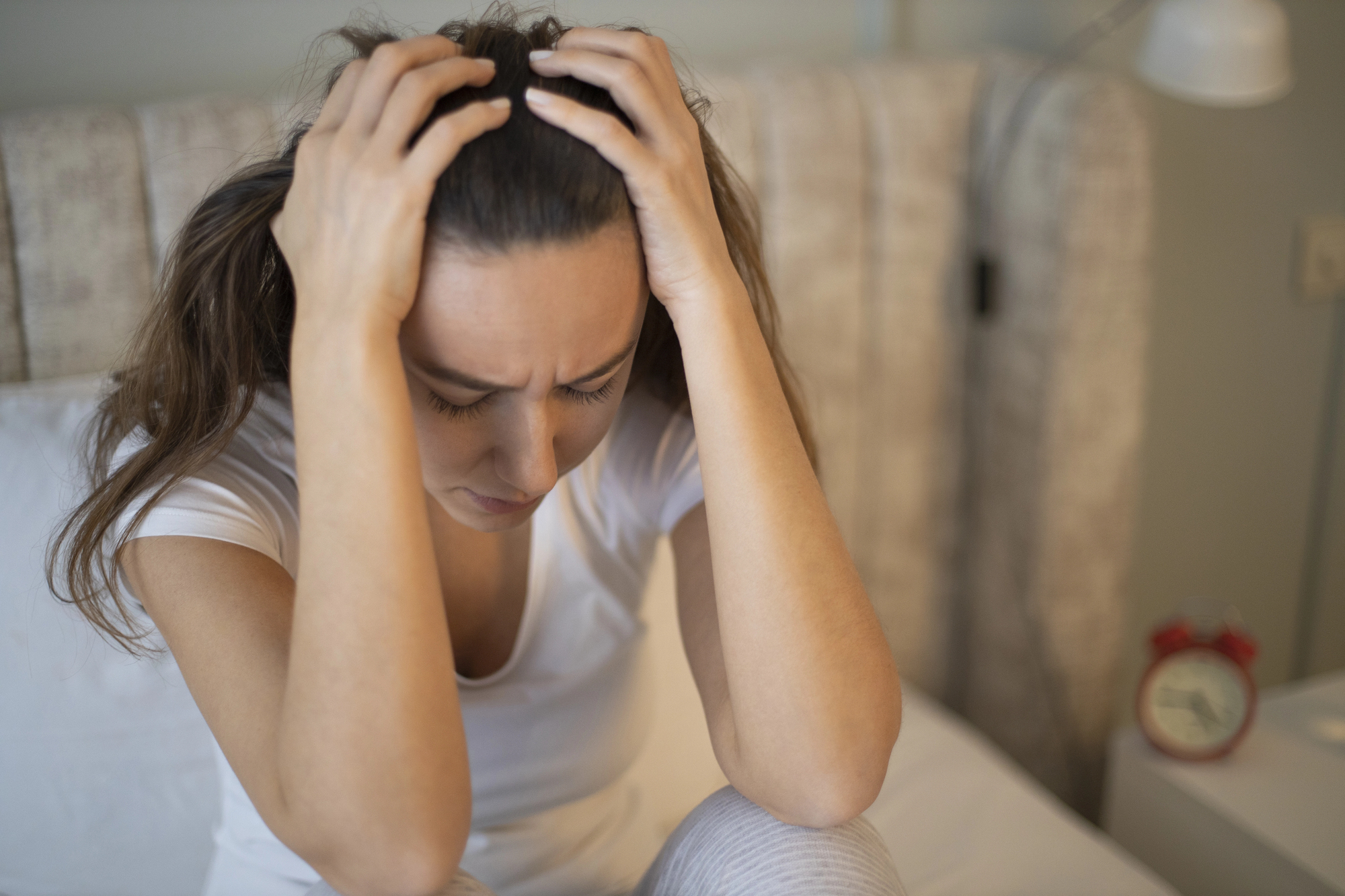
Have you ever felt drained the moment you wake up, before the day has even begun? You slept, but stress and fatigue are already there. Concentration drops, so does motivation, and the body seems to be running in slow motion.
It's not just «in your head». Both acute and chronic stress act on the brain, sleep, the nervous system, and therefore on your physical and mental balance. Stress can trigger mental fatigue, physical fatigue, sleep disorders, muscle tension, headaches, or genuine emotional exhaustion.
The hardest part is understanding what this fatigue is telling you. Is it a simple energy dip, mental overload, anxiety, burnout, asthenia, or a sign of something deeper? When exhaustion persists, doubt sets in.
This article is here to help you see things more clearly. The aim is simple: understand the link between stress and fatigue, identify the right symptoms, and discover natural solutions to reduce stress, regain energy, and break out of this vicious cycle in your daily life.

Key Takeaways
- Sleeping better, moving a little, and cutting back on stimulants remain the most useful foundations.
- Slow breathing, meditation, and genuine mental breaks can help release pressure.
- Supplements can be useful, but mainly when a deficiency or clear indication exists.
- If fatigue lasts several weeks or is accompanied by other signs, you should seek medical advice.
Why does stress cause so much fatigue?
Have you ever had a day with no physical effort, yet felt as though you'd run a marathon? That's often how stress works. Initially, it exists to protect you. It puts the body on alert to respond to a challenge. But when that alert lasts too long, it drains your reserves. Sleep becomes lighter, concentration drops, tensions accumulate, and fatigue takes over. The WHO (World Health Organisation) points out that stress can cause difficulty concentrating, pain, and sleep disturbances, and that chronic stress can worsen existing health problems.
What role does cortisol play in energy loss?
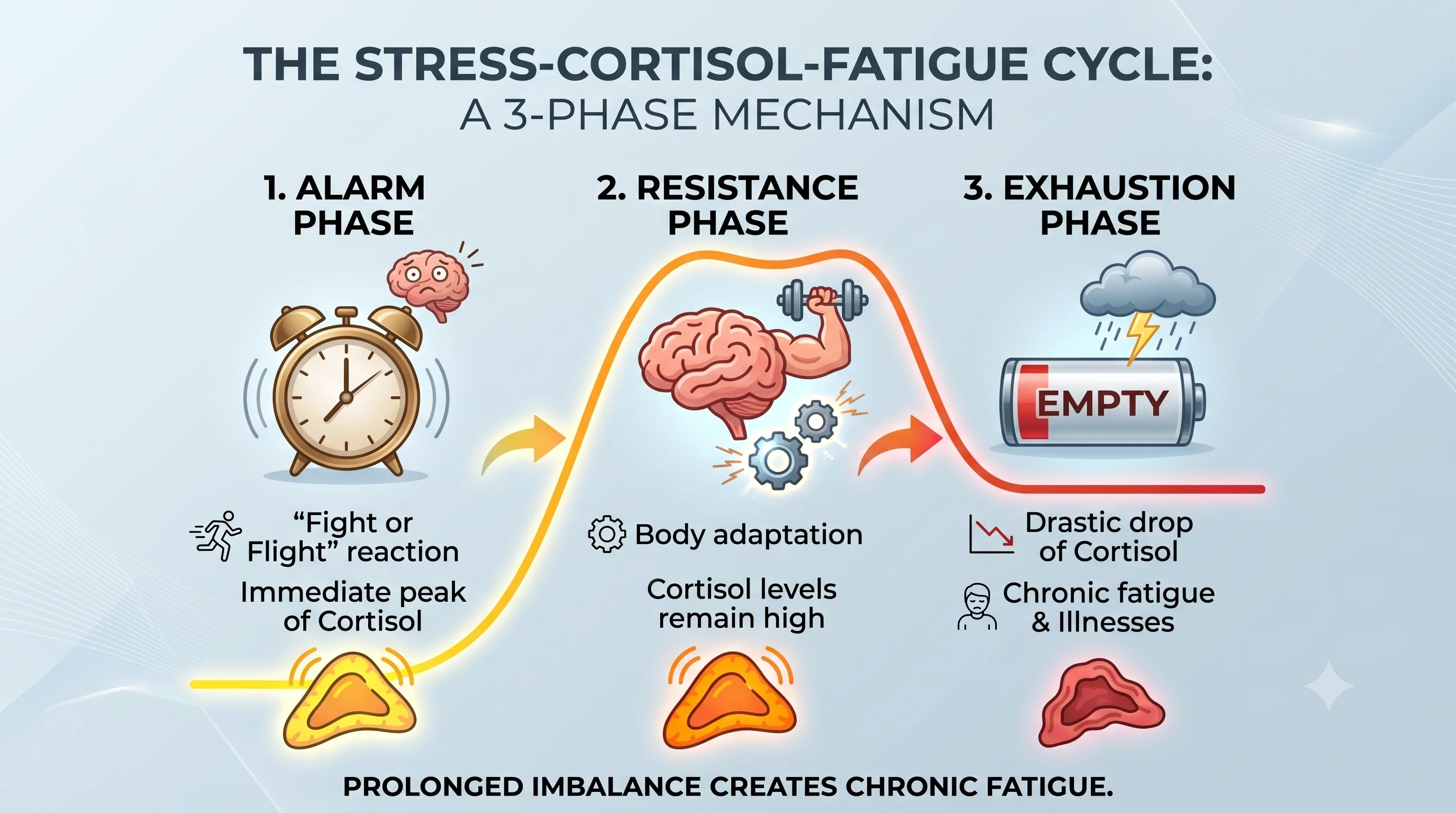
Cortisol is often called «the stress hormone». Yet it isn't the enemy. In small doses and over a short period, it helps the body stay alert. It increases the availability of energy to deal with a situation perceived as urgent. Cortisol also suppresses inflammation. But when stress becomes frequent or prolonged, this response can become dysregulated. The result: you feel more tense, less rested, and sometimes drained — even without intense effort. Landmark research shows that cortisol plays a central role in the stress response, metabolism, and the balance of several bodily functions.
Why does mental stress also exhaust the body?
Because mental stress doesn't stay in the head. It also passes through the body. When you ruminate, anticipate, manage too many things, or live under pressure, the nervous system stays in alert mode. This can manifest as headaches, aches, muscle tension, digestive issues, or less restorative sleep. The NHS and WHO clearly state that stress can cause physical pain, difficulty sleeping, irritability, and concentration problems. In short, even if the source is mental, the impact is also physical.
How do stress and fatigue lock into a vicious cycle?
The mechanism is often straightforward. You are stressed, so you sleep less well. Because you recover poorly, you are even more tired the next day. And because you are tired, you manage pressure, emotions, and unexpected events less effectively. Stress then rises again. Sleep disturbances also more frequently leave behind franck exhaustion, irritability, and reduced attention during the day. This vicious cycle explains why stress-related fatigue can persist even when you think you've «had a bit of rest».
Key takeaways:
- Stress mobilises the body, but wears it out when it persists.
- Cortisol helps you react, but can become exhausting if it stays elevated for too long.
- The mind also fatigues the body.
- The combination of stress + poor sleep often sustains fatigue and reduced functioning.
What are the symptoms of stress and fatigue?
Have you ever felt as though everything became heavier, for no clear reason? That's often how stress and fatigue take hold. They don't only affect mood. They can also impact the body, sleep, concentration, and day-to-day behaviour. Stress can produce physical, mental, and even social signs, such as low energy, diffuse aches, irritability, or withdrawal.
What are the symptoms of severe stress?
Severe stress isn't simply «having a lot to do». It can cause headaches, dizziness, muscle aches, digestive problems, cardiac palpitations, or a feeling of tension from morning to night. Mentally, it can also make you more irritable, more anxious, more easily overwhelmed, and complicate decision-making. Sleep may become too short, too light, or conversely too long without being restorative.
In practice, many people say the same thing: «I can't switch off anymore». This is a reliable warning sign. When the brain stays in alert mode, the body follows. And when this persists, the feeling of wear and tear becomes more pronounced.
How do you recognise deep fatigue caused by stress?
Deep stress-related fatigue doesn't always look like a simple slump. You may wake up already tired, lack drive, struggle to concentrate, forget simple things, or feel that the smallest task requires too much effort. MedlinePlus notes that fatigue is a sensation of weariness, tiredness, or lack of energy, and that it can be a normal response to emotional stress or lack of sleep.
The real trap is duration. If this fatigue sets in for several weeks, disrupts your daily life, or doesn't improve despite rest, you shouldn't dismiss it. It's not necessarily serious, but it deserves to be understood.
Why do you feel tired all the time with an urge to sleep?
You sleep, but still feel like sleeping? This is common when stress disrupts sleep. Even brief stress-related insomnia can lead to daytime drowsiness, fatigue, and reduced concentration. And when nights repeat this way, the body recovers poorly.
However, it's important to stay clear-headed: the urge to sleep all the time isn't caused by stress alone. MedlinePlus indicates that excessive sleepiness may also be linked to a sleep disorder, chronic sleep deprivation, certain medications, shift work, an underactive thyroid, anxiety, or depression. That's why persistent fatigue sometimes warrants a proper check-up.
Can stress cause muscle fatigue?
Yes, it can. Stress can cause muscle tension or pain, especially in the neck, shoulders, back, or jaw. After remaining contracted for extended periods, muscles give a feeling of heaviness, discomfort, or physical exhaustion. The NHS (National Health System) clearly lists muscle tension or pain among the common symptoms of stress.
However, an important distinction must be made. Stress can explain tense, aching muscles, but it doesn't explain everything. If the pain is intense, if you experience true muscle weakness, or if physical fatigue becomes prolonged, another cause should be sought with a healthcare professional. Other issues — such as certain sleep disorders, anaemia, thyroid conditions, or other illnesses, cancer — can also cause significant fatigue.
Key takeaways:
- Stress can produce physical, mental, and behavioural signs.
- Deep stress-related fatigue often goes beyond a simple need for rest.
- The urge to sleep may stem from stress, but also from a sleep disorder or another medical cause.
- Stress can promote muscle fatigue through tension and pain.
What can deep fatigue be hiding?
You rest, but nothing changes? In that case, the fatigue deserves closer attention. Deep fatigue can be linked to stress, lack of sleep, a deficiency, an infection, an anxiety disorder, depression, a thyroid condition, anemia, or another health problem. Fatigue is not a disease in itself. It is a symptom. And when it persists, its cause must be identified.
When do we speak of asthenia?
Asthenia is the term used when fatigue becomes abnormal. In short, it persists despite rest, or keeps returning. The French National Health Insurance (Assurance Maladie) clarifies that brief fatigue is not concerning, but becomes abnormal when it persists in spite of rest that should suffice.
Greater attention is warranted if this fatigue is profound, interferes with daily tasks, or is accompanied by other signs — such as breathlessness, unexplained weight loss or gain, pain, fever, or sleep disturbances. In that case, a medical consultation is advisable.
What illnesses can cause deep fatigue?
Several illnesses can produce significant fatigue. Among the common causes are anemia, certain endocrine disorders such as hypothyroidism, chronic infectious diseases, autoimmune conditions, certain cancers, chronic diseases, and sleep disorders. The French National Health Insurance also lists these causes when discussing asthenia.
MedlinePlus adds other frequent causes: depression, anxiety, sleep apnoea, insomnia, certain medications, or an overactive or underactive thyroid. In other words, prolonged fatigue is far from a vague «catch-all» symptom. It deserves serious consideration.
Why can intense fatigue appear without any apparent reason?
In reality, intense fatigue rarely arrives for no reason. Most of the time, the cause simply isn't immediately visible. It may involve emotional stress, poor-quality sleep, iron deficiency, the onset of an infection, a medication side effect, or a mood disorder. MedlinePlus notes that fatigue can have many causes — sometimes medical, sometimes lifestyle-related.
Sometimes the body accumulates small alerts: nights that are too short, mental overload, irregular meals, nervous tension, little recovery time. Individually, each seems «manageable».
Together, they can produce a very real intense fatigue. If it persists, avoid jumping too quickly to the conclusion of mere overload.
What is the exhaustion phase of stress?
Stress often follows a three-stage pattern: alarm, resistance, then sometimes exhaustion. The INRS (Institut national de recherche et de sécurité pour la prévention des accidents du travail et des maladies professionnelles) explains that the body responds to a stressful situation through these different phases. The exhaustion phase appears when the body has remained on high alert for too long and can no longer compensate.
At this stage, the person may experience physical, mental, and emotional exhaustion. The NHS (National Health System) also explains that severe or prolonged stress can lead to this state of exhaustion known as burnout. The WHO, for its part, describes occupational burnout through a feeling of exhaustion, mental distancing from work and private life, and reduced effectiveness.
What are the most common causes?
Why do so many people feel drained without being «ill» in the classical sense? The most common causes are often very concrete: lack of sleep, stress, anxiety, daily overload, and — particularly for women — painful periods, pregnancy, iron deficiency, or an unbalanced lifestyle. These causes may seem ordinary, but their effects are not.
Can lack of sleep sustain exhaustion?
Yes, clearly. Repeated lack of sleep sustains fatigue, diminishes attention and concentration, slows recovery, and weakens emotional balance. MedlinePlus notes that certain sleep disorders, such as insomnia or sleep apnoea, are among the common causes of fatigue.
The problem is that you can sleep «long enough» without truly recovering. Sleep that is fragmented, too light, or disrupted by stress does not properly recharge the body. This is often where the vicious cycle begins: the more tired you are, the less effectively you manage stress, and the more sleep deteriorates.
How do mental overload and anxiety worsen fatigue?
Mental overload causes fatigue because it keeps the brain on alert while simultaneously keeping the body tense. You have to think of everything, anticipate, manage, decide. And this wears you out, even without physical exertion. The WHO (World Health Organisation) highlights that stress can make concentration more difficult, disrupt sleep, and be accompanied by anxiety, irritability, or joint and muscle pain.
Anxiety often adds a layer of tension. The body remains mobilised. Muscles tighten. The heart beats faster. Rumination increases. The result: you feel exhausted more quickly, and you recover less well. MedlinePlus classifies anxiety and depression among the frequent causes of fatigue.
Why do certain periods in women's lives — such as periods or pregnancy — cause greater fatigue?
Some life stages demand more energy from the body. During pregnancy, fatigue is common, especially in the first trimester. The NHS (National Health System) explains that the hormonal changes of early pregnancy can make a woman feel tired, nauseous, and more emotional.
Before menstruation, hormonal fluctuations can also cause physical and emotional changes. The NHS (National Health System) notes that premenstrual syndrome is linked to these hormonal variations. And if periods are very heavy, they can contribute to iron deficiency or anemia — two classic causes of fatigue. The Health Insurance System lists fatigue, breathlessness, dizziness, and headaches among the possible signs of iron deficiency linked to heavy bleeding.
In other words, during these periods, fatigue is not «in your head». It can be hormonal, metabolic, or linked to iron loss. If it becomes too severe or unusual, don't hesitate to discuss it with a healthcare professional.
How to fight stress and fatigue naturally?
Have you ever felt as though you're pushing yourself to the limit, then carrying on as if nothing happened? The problem is that the body always ends up presenting the bill. To regain energy, it's often necessary to return to the basics: sleep, movement (preferably outdoors or in open spaces), breathing, nutrition (healthy food) and mental recovery. These are the simplest levers — and also the most reliable.
{{cta}}
What lifestyle habits help restore energy?
When fatigue sets in, we often look for a quick fix. In reality, it's often small, repeated habits that make the difference. The goal isn't perfection. The goal is to give the body a more stable rhythm.
Improving sleep
Better sleep remains the foundation. Try to go to bed before midnight and wake at consistent times. Keep your bedroom quiet, cool, and dark. Cut off screens at least 2 hours before sleep. Also avoid heavy meals, alcohol, and caffeine in the evening. These are simple steps, but they genuinely support recovery.
Reducing stimulants
When exhausted, many people reach for coffee as a lifeline. In the short term, it certainly helps. But too much caffeine can also fuel anxiety and disrupt sleep, especially when consumed late in the day. The NHS also points out that alcohol, tobacco, and caffeine don't address stress at its roots. They sometimes provide momentary relief, then maintain the problem.
Resuming gentle physical activity
When you feel drained, moving seems counterintuitive. Yet gentle activity often helps. A walk, some stretching, yoga, or cycling at your own pace can already make a difference. The CDC notes that physical activity helps you feel better, sleep more soundly, and can reduce short-term feelings of anxiety. Even a modest amount is better than nothing.
What methods help calm stress?
Have you ever noticed that the mind never stops, even when the body is sitting still? In such cases, it's sometimes necessary to calm the nervous system before trying to «hold on». Mind-body approaches can help, especially when stress has become a habit.
Heart rate coherence
Heart rate coherence is based on slow, regular breathing. In practice, you slow your breath for a few minutes and extend the exhalation phase — somewhat like breathing during swimming. Research on regulated breathing practices shows they can reduce perceived stress. The CDC also recommends deep breathing among the simple gestures for better pressure management. It's practical, quick, and often calming from the very first minutes.
Meditation
Meditation doesn't require «emptying the mind». It mostly involves returning to the present moment without adding tension. The NCCIH notes that meditation and mindfulness can be useful for managing stress and anxiety more effectively, though results vary depending on the person and the method. In other words, it's not magic. But it's a genuine tool for mental training — and one that allows energy to flow more freely through the body.
Mental disconnection
Sometimes, the brain simply needs silence. Taking breaks, turning off notifications, reducing continuous exposure to news and social media, and carving out genuine time free from demands can help release pressure. The CDC advises taking breaks from news and social media, making time to breathe, and reconnecting with calming activities or loved ones.
What natural supports can be useful?
Food supplements do not replace rest, a balanced diet, or medical evaluation when fatigue persists. However, they may have value in certain cases, particularly when a deficiency or specific need has been identified. The idea isn't to take everything. The idea is to choose wisely.
Magnesium and B vitamins
Magnesium plays a role in the functioning of muscles and nerves, among other things. B vitamins, especially B12, also matter: a B12 deficiency can cause fatigue, weakness, memory issues, or mood disturbances. So yes, these nutrients can help — especially if you're lacking them. They are not universal boosters.
Omega-3 and probiotics
Omega-3 fatty acids are found notably in oily fish, certain oils, eggs, and some supplements. They can be incorporated into a healthy lifestyle, but do not replace a genuine attitude towards sleep, stress, and nutrition. For probiotics, they have been quite a deception. It is prebiotics that are important, represented by fibers, especially in case of digestive dysregulation and excessive weight.
Adaptogenic plants
Certain adaptogenic plants, such as ashwagandha, are currently receiving a great deal of attention. The NCCIH notes that some preparations have shown benefits for stress, sleep, and sometimes fatigue. But caution remains essential: doses and extracts vary, long-term safety is not established, and this plant can be problematic during pregnancy, in case of thyroid disorders, or when combined with other treatments.
When should you be concerned and seek medical advice?
What if it wasn't just «a rough patch»? That's the right question. Occasional fatigue after a stressful period is common. However, fatigue that persists, worsens, or changes your daily life warrants closer attention. MedlinePlus and the National Institute on Aging (NIA) recommend consulting a healthcare professional if fatigue persists for several weeks without improvement.
What signs should raise the alarm?
Greater vigilance is needed if fatigue is accompanied by other signs such as fever, unexplained weight loss, regular night sweats, an abnormal feeling of cold, dry skin, constipation, very low mood, or repeated waking during the night. These signs don't necessarily mean something serious is wrong. But they justify not attributing everything to stress.
When should you consult a doctor for persistent fatigue?
Seek medical advice if you have been fatigued for several weeks, if rest makes little difference, or if fatigue is clearly interfering with your work, relationships, or daily life. It is also important if you feel weak, short of breath, dizzy, or if the fatigue arrives without an obvious cause. The goal is not to panic unnecessarily. The goal is to avoid missing a treatable cause.
What tests can help identify the cause?
The first «examination» is often the conversation with a healthcare professional: sleep, activity, diet, stress, medications, menstrual cycle, medical history. From there, a clinical examination and appropriate blood tests may be suggested depending on the context. Common avenues include a complete blood count to check for anemia, ferritin for iron stores, TSH for thyroid function, vitamin B12, or sometimes blood glucose depending on symptoms — as well as a full neurotransmitter profile covering serotonin, dopamine, GABA, and acetylcholine, and a cortisol profile, potentially analysed over three days in blood, saliva, and urine. These tests are not all routine: they depend on your history and associated signs.
Tissue Repair Serum
The Tissue Repair Serum version: apply by squeezing a few drops from the dropper into your hand. Enjoy the fragrance, followed by a slightly euphoric sensation.


FAQ
Everything you need to know before placing an order: simple and clear.
What are the symptoms of fatigue and stress?
The symptoms of stress and fatigue can be physical, mental, and emotional. The most common include low energy, sleep disturbances, headaches, difficulty concentrating, irritability, muscle aches, and the feeling of never truly recovering.
Stress can also cause palpitations, digestive problems, and a sense of being overwhelmed
What are the symptoms of severe stress?
Severe stress often manifests as a body in a near-constant state of alert.
You may experience muscle tension, dizziness, pain, a racing heart, disturbed sleep, as well as looping thoughts, anxiety, intense irritability, or difficulty stepping back.
Can stress cause liver pain?
Stress alone does not cause a clearly identified «liver pain». However, it can promote abdominal pain, stomach and duodenal discomfort, and muscle tension that may be felt in the upper abdomen. If the pain is located on the right side under the ribs, persists, recurs frequently, or is accompanied by fever, nausea, or jaundice, a doctor should be consulted, as other causes are possible — such as a gallbladder problem or liver disease.
How do you fight fatigue and stress?
To combat stress and fatigue, start with the basics: sleep better, limit stimulants, resume gentle physical activity (meaning moderate exercise), and allow yourself genuine mental breaks. Slow breathing exercises, meditation, and a more regular lifestyle can also help. If fatigue persists despite these measures, seek a more specific cause with a healthcare professional.
What is the exhaustion phase of stress?
The exhaustion phase is the point at which the body can no longer compensate for stress that has lasted too long. The classic model describes three stages: alarm, resistance, then exhaustion.
At this stage, the person may experience physical, mental, and emotional exhaustion, with a marked decline in energy and the ability to cope
Latest posts
Did you enjoy this latest article? If so, you might be interested in this selection.

Ready to slow down the aging process?
Sign up for our newsletter and join the thousands of people who follow us to regain energy, vitality, and well-being.
