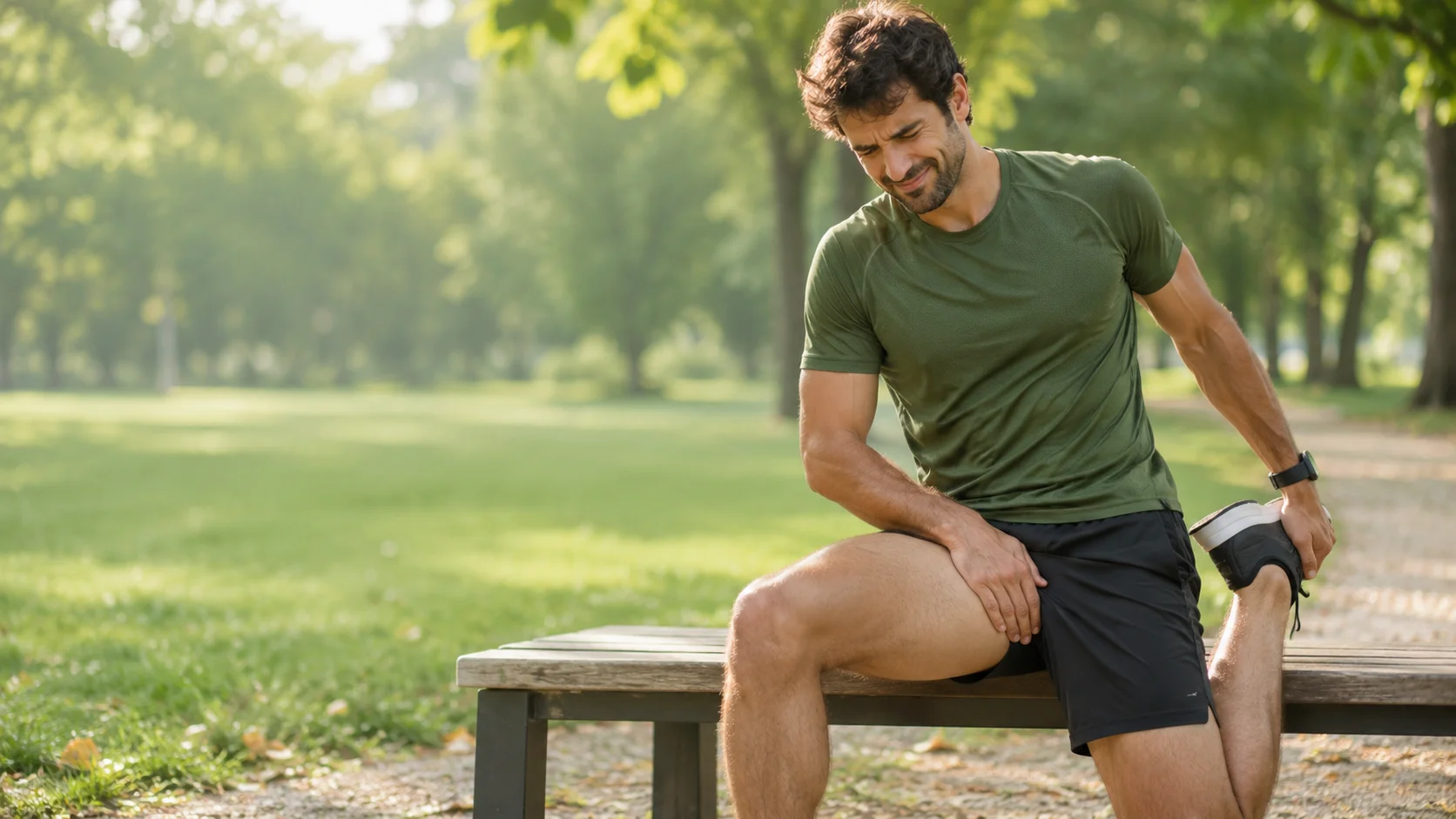
Do the stairs suddenly feel harder after a hill walk or getting back into exercise? You expected to feel fit, and instead your thighs complain with every step.
Muscle soreness can come on after unaccustomed exercise. It appears after a delay and usually eases within a few days. But not every muscle pain is soreness: the context and any other symptoms matter.[1]
Here is how to adjust your activities, choose comfort measures and recognise when you need medical advice.

Key Takeaways
- Adjust your activity, without doing another hard session to make the pain go away.
- Allow yourself rest and watch for gradual improvement.
- Look for comfort, without confusing relief with faster recovery.
- Keep your fluid intake suited to your needs.
- Build back up gradually, without treating soreness as proof of success.
- Get advice for unusual pain, marked weakness or dark urine.
What should you do as soon as your muscles feel sore?
What can you do today if your muscles are stiff and painful after exercise? Start by cutting back on whatever puts a heavy load on them, without trying to “push through” the pain.
You can plan your day around a few pointers:
Light activity may feel good, but it does not guarantee that soreness will go quickly. Adjust it to your comfort. If the pain is severe, unusual or stops you using a limb normally, get it checked.[3]
How can you tell soreness from cramp, injury or myalgia?
Does “soreness” describe all your aches? These situations have different features.
These pointers are not enough to make a diagnosis. Myalgia (muscle pain) can be linked to exercise, but also to an infection, a medicine or another illness. Our article on myalgia will look at these causes in more depth.[1, 3]
If the pain is near a joint, a tendon may also be involved. Our guide to tendonitis and how to manage it helps explain the difference. For pain that lasts, our page on persistent muscle, joint and nerve pain offers other pointers.
Why does soreness follow unaccustomed exercise?
Why might you ache the day after an activity you enjoyed? New exercise, or exercise that is harder than usual, can cause changes in the muscle and a local inflammatory response linked to delayed pain.[1]
So-called eccentric contractions, where a muscle works while lengthening, are often involved. This happens, for example, when you slow a movement down or walk downhill.[11]
So you can be well trained for one activity and still get sore after another. A walk with a lot of downhill does not necessarily resemble your usual sessions.
Muscle soreness is not caused by a build-up of lactic acid that needs flushing out. The idea is still widespread, but it does not describe how soreness happens.[1]
And how sore you get is not something to aim for. A session can be useful without leaving you in pain for several days.
{{cluster}}
How long can it last?
Should you worry if the discomfort gets worse after the first night? Muscle soreness is, by definition, delayed-onset pain.
It often becomes noticeable in the hours after exercise or the next day, then eases as the muscle repairs itself over a few days. These timings are a guide, not a rule for everyone.[1, 2]
What matters is the direction of travel: are you gradually getting your usual movement back? Is the discomfort easing?
Pain that lasts more than 3 days deserves advice.[3] The same applies if it is getting worse or does not fit what you would expect: if your muscle soreness is persistent or worsening, contact your physiotherapist or GP, or call NHS 111.[2] Do not wait for a theoretical time limit to pass if you have a warning sign.
Should you keep exercising or rest?
Torn between cancelling everything and repeating exactly the same session? Adjusting may be enough when symptoms are mild and fit ordinary muscle soreness.
Lower the intensity and choose comfortable movements. If an exercise clearly changes how you move or increases the pain, put it off. Avoid repeating a hard session on the same muscles just to “loosen them up”.
Build back up gradually, taking into account your mobility and your ability to move normally. General physical activity advice encourages gradual progression and stopping an exercise if you feel pain or excessive tiredness.[5]
If you suspect an injury, this light-recovery approach does not replace first aid and seeing a professional.[4]
Massage, stretching, heat and cold: what can you expect?
Can something feel good without speeding up muscle repair? Yes. Keeping these goals apart saves you piling on techniques for no reason.
Can massage make you more comfortable?
A 2020 review reports a small improvement in muscle soreness with sports massage, with no proven benefit on strength or sprinting.[6] A 2018 review also reports a reduction in soreness with massage.[8]
Keep the pressure bearable. Avoid massaging an area where you suspect a recent injury, or a swollen calf with no known cause. Get the situation checked before carrying on.
If you are thinking of using a massage oil, our article on anti-inflammatory essential oils sets out their limits and precautions.
Does stretching speed up recovery?
A meta-analysis published in 2025, covering 15 studies and 465 participants, found no significant reduction in muscle soreness with stretching after exercise.[7] Don’t force a stretch in the hope of recovering faster.
Do you need heat or cold?
The 2018 review reports a reduction in soreness with cold, including cryotherapy, although its effect is small; hot-water immersion brought no significant improvement.[8]
Choose a moderate temperature, protect your skin and stop if you feel worse. There is no need to go for extreme temperatures.
If you suspect a recent injury, get suitable advice: muscle soreness and a muscle strain are not managed in the same way.
What about fluids, food and supplements?
Do you need a special drink or food after every session? Adjust how much you drink to the exercise and the heat[5], without forcing yourself to drink excessive amounts. If you have been given specific medical advice, follow it.
Drinking more does not flush out a supposed build-up of lactic acid causing the pain.[1]
Our article on natural muscle relaxants looks in more depth at the limits of supplements and at comfort measures. Unusual pain needs assessing rather than trying one product after another.
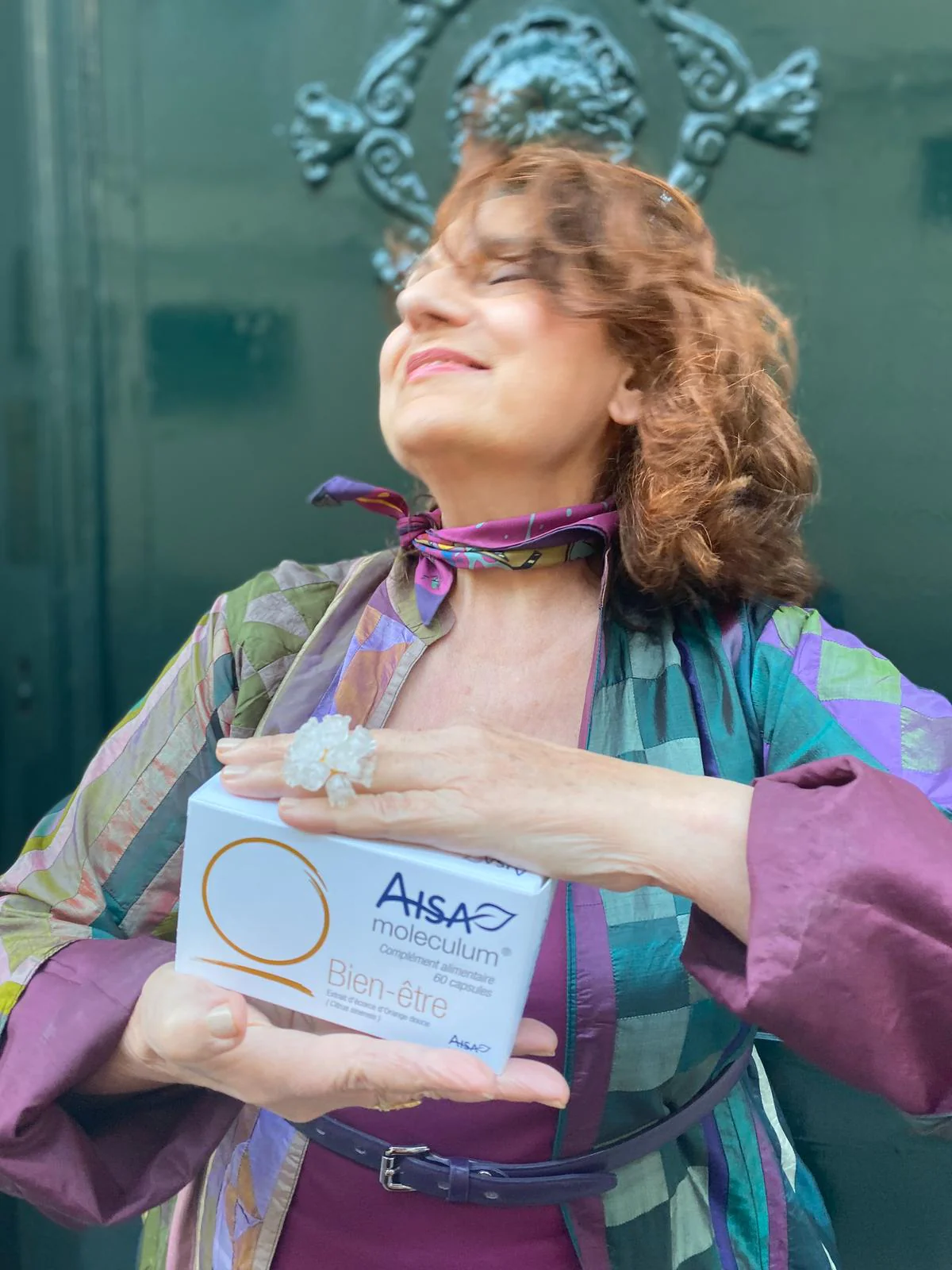
If you are considering AISA moleculum capsules, check their ingredients and ask a professional whether they suit your situation and any medicines you take.
{{cta}}
How can you limit soreness next time?
Getting back into exercise after a break and keen to return to your usual level quickly? Give yourself realistic progress.
Start with a shorter or easier session than you had in mind. Build up gradually, watching how your body responds. Before exercise, warm up properly; it does not guarantee you will avoid soreness, but it is part of well-organised practice.[5]
When should you get medical advice?
Does the pain seem out of proportion to the exercise you did? Don’t automatically put it down to muscle soreness.
Get medical help straight away if you have very severe pain, unusual weakness or dark urine (tea- or cola-coloured), especially after intense exercise. These signs can point to rhabdomyolysis, a muscle condition that needs prompt treatment. You may not have all of these signs at once.[9]
If pain came on suddenly during a session, stop any exercise or activity. Get urgent advice (in the UK, call NHS 111) if the pain is severe or getting worse, if there is a lot of swelling or bruising, or if you cannot put any weight on it or walk more than a few steps.[4]
Contact a doctor if the pain lasts more than 3 days, is severe with no clear cause, or comes with signs of infection. If you have a high fever, get help without delay.[3] Pain that keeps coming back also deserves advice. If it started after you began a medicine or changed the dose, tell your doctor[3]; do not stop your medicine on your own.[10]
Read next
- Natural muscle relaxant: how can you ease muscle tension?
- Anti-inflammatory essential oils: what can you expect?
Source
- AFM-Téléthon (French muscular disease association), “Douleurs musculaires, courbatures, crampes” (in French), 11 August 2026. Definitions (muscle soreness as a form of myalgia; cramp); delayed pain after exercise, then muscle repair within a few days; lactic acid build-up plays no role. afm-telethon.fr → https://www.afm-telethon.fr/fr/termes/douleurs-musculaires-courbatures-crampes
- Leicestershire Partnership NHS Trust, “MSK physiotherapy resources: FAQs” (undated). Delayed-onset muscle soreness (DOMS) felt in the days after activity and normally harmless; if soreness is persistent or worsening, consult your physiotherapist or GP, or call 111. leicspart.nhs.uk → https://www.leicspart.nhs.uk/msk-physiotherapy-resources-getting-started/msk-physiotherapy-resources-faqs/
- MedlinePlus (US National Library of Medicine), “Muscle aches”, reviewed 1 April 2025. Causes of muscle aches (overuse, infection, medicines, illness); when to contact a provider: pain lasting more than 3 days, severe unexplained pain, signs of infection, pain linked to starting or changing the dose of a medicine; high fever among the urgent signs. medlineplus.gov → https://medlineplus.gov/ency/article/003178.htm
- NHS, “Sprains and strains”, reviewed 23 April 2024. What a strain is; stop any exercise or activity; when to see a GP and when to get urgent advice from NHS 111. nhs.uk → https://www.nhs.uk/conditions/sprains-and-strains/
- Assurance Maladie (French national health insurance), “L’activité physique selon ses aptitudes et en sécurité” (in French), updated 26 August 2026. Gradual progression, stopping exercise in case of pain or excessive tiredness, warming up, fluids according to effort and heat. The page does not cover muscle soreness. ameli.fr → https://www.ameli.fr/assure/sante/themes/activite-physique-sante/l-activite-physique-selon-ses-aptitudes-et-en-securite
- Davis HL, Alabed S, Chico TJA, “Effect of sports massage on performance and recovery”, BMJ Open Sport & Exercise Medicine, 2020. 29 studies, 1,012 participants; small improvement in muscle soreness; no evidence of an effect on strength, jump, sprint, endurance or fatigue. pubmed.ncbi.nlm.nih.gov → https://pubmed.ncbi.nlm.nih.gov/32426160/
- Zhang P, Chen J, Xing T, “Post-exercise stretching versus no stretching”, Frontiers in Physiology, 2025. Meta-analysis of 15 studies, 465 participants; no significant reduction in muscle soreness in the conditions studied. pubmed.ncbi.nlm.nih.gov → https://pubmed.ncbi.nlm.nih.gov/41103301/
- Dupuy O et al., “Post-exercise recovery techniques”, Frontiers in Physiology, 26 April 2018. Systematic review with meta-analysis: reduced soreness with several techniques, including massage and cold; small effect of cryotherapy; no significant improvement with hot-water immersion; results sometimes at variance. frontiersin.org → https://www.frontiersin.org/journals/physiology/articles/10.3389/fphys.2018.00403/full
- CDC / NIOSH, “Signs and Symptoms of Rhabdomyolysis”, 28 October 2026. Muscle pain more severe than expected, dark (tea- or cola-coloured) urine, feeling weak or tired; one or more signs; seek medical treatment right away. cdc.gov → https://www.cdc.gov/niosh/rhabdo/signs-symptoms/
- Assurance Maladie, “Crampes : que faire et quand consulter ?” (in French), 12 August 2025. Most cramps pass within a few minutes; do not stop a current treatment on your own. ameli.fr → https://www.ameli.fr/assure/sante/themes/crampes-musculaires/que-faire-crampes
- Cleveland Clinic, “Delayed Onset Muscle Soreness (DOMS): What It Is & Treatment”, updated 19 December 2025. Eccentric exercises (tensing a muscle while it lengthens), including walking or running downhill. my.clevelandclinic.org → https://my.clevelandclinic.org/health/diseases/delayed-onset-muscle-soreness
You might be interested in this product
Anti-inflammatory capsules
«Inside-out» dietary supplement supports the integrity of the intestinal barrier and a balanced microbiome, helping to manage stress. 2 to 4 capsules daily on an empty stomach. Content corresponds to a take for 2–3 weeks. European clinical study on 138 healthy patients aged 65–85, for 45 days.

TARIF
€
120.00
A European clinical study involving 138 healthy patients (ages 65–85).
FAQ
Everything you need to know before placing an order: simple and clear.
Can you get muscle soreness without doing sport?
Can everyday activity be enough? Unaccustomed effort such as gardening or moving house can work your muscles. But pain with no obvious exertion can have other causes and needs checking if it persists.[3]
Does muscle soreness mean the session worked?
Do you need to hurt to make progress? No. Muscle soreness is not a reliable sign of success. Regular, suitable exercise does not need to cause significant pain.
Should you work the same muscle again the next day?
Will putting a heavy load on it help it recover? Avoid pushing it. Adjust your activity to your discomfort and build back up gradually once movement feels comfortable again.[5]
Does drinking a lot flush out lactic acid?
Is that the right explanation for the pain? No. A build-up of lactic acid does not explain delayed muscle soreness. Drink according to your needs, without expecting water to take the pain away.[1]
Is sudden pain during a session muscle soreness?
Can you carry on and wait for it to pass? Sudden pain during exercise points more towards an injury or another cause. Stop exercising and get appropriate advice.[4]
Latest posts
Did you enjoy this latest article? If so, you might be interested in this selection.


Ready to slow down the aging process?
Sign up for our newsletter and join the thousands of people who follow us to regain energy, vitality, and well-being.

Your cart summary
Product Name
$0
$0
-
Thank you! Your submission has been received!
Oops! Something went wrong while submitting the form.
+
Success message won't be visible to user. Coupon title will be listed below if it's valid.
Coupon1
Coupon2
Success message won't be visible to user.
Error message won't be visible to user.