
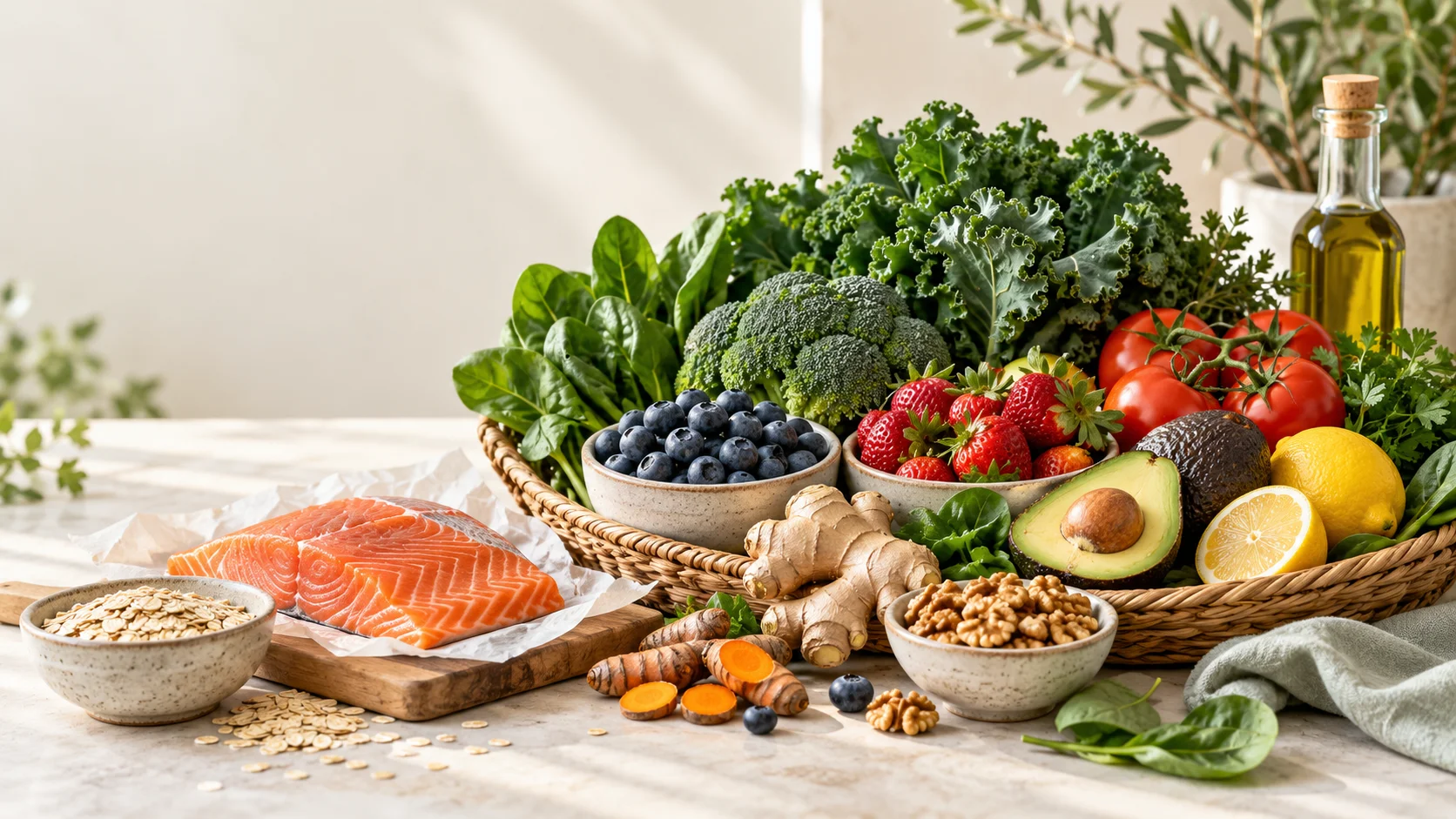
What should you buy when you want to eat better and look after your health? In the supermarket aisles, advice about “superfoods” can quickly complicate a very everyday question: what’s for dinner tonight?
The anti-inflammatory foods usually recommended belong mostly to familiar families: fruit, vegetables, beans and pulses, whole grains, oily fish, nuts and vegetable oils. Their value lies in a varied diet, followed over time.
Here is a list to help you build your meals. You don’t need to buy everything or like everything: choose foods that fit easily into your cooking.

Key Takeaways
- Vary your fruit and veg, with ones you like.
- Plan two meals with beans or lentils each week.
- Try one whole grain that suits your habits.
- Alternate your fish, with one oily portion a week.
- Choose unsalted nuts, unless you’re allergic.
- Build a small, practical basket.
- Ill or symptoms persist? Get personalised advice.
Which foods should go in your basket?
Want a quick answer before you shop? This table brings together the main food families to know. It gives examples, without claiming to list every food or to give each one a proven clinical effect.
These families reflect the main lines of healthy-eating guidelines and of the eating patterns studied in research. The table is a tool for choosing, not a prescription.[1, 2]
Can foods really reduce inflammation?
Can a food work like a medicine? Calling a food “anti-inflammatory” does not mean that one portion treats a disease.
Researchers study, in particular, the links between eating habits and blood markers of inflammation. A review of clinical trials reports favourable results for the Mediterranean diet on some markers, with large differences between studies. Not all results are statistically conclusive.[3]
These foods are interesting mainly for their fibre, unsaturated fats and plant compounds. But the presence of a compound is not enough to prove that a food, eaten on its own, will reduce your symptoms.
For the bigger picture, read our complete guide to the anti-inflammatory diet.
Which fruit and vegetables should you choose?
Already have carrots and apples at home? Then you have what you need to start. There’s no need to wait for a rare ingredient to improve your meals.
Vary your vegetables through the week: squash soup, spinach with eggs, a tomato salad or broccoli with rice. Make room for whole fruit, too.
The UK guideline is at least five portions of fruit and vegetables a day, in total. Fresh, frozen and tinned all count, but beans and pulses count as only one portion a day, however much you eat.[4]
Do you need to eat berries?
Find blueberries too expensive? Berries contain interesting plant compounds, but they are not compulsory. Alternate them with whatever fruit is available and affordable.
A pear in autumn, a kiwi in winter or strawberries in season can all find their place in a varied diet. Plain frozen berries are another easy way to ring the changes.
Should you eat vegetables raw?
Is soup less useful than salad? You can alternate raw and cooked. What matters is finding ways of preparing them that you enjoy and tolerate.
If raw vegetables don’t agree with you, try cooked ones, then adjust the amounts. A big salad every evening is not an obligation. If digestive problems persist, ask for personalised advice.
Which beans, lentils and whole grains are best?
Looking for filling ingredients that keep well? Lentils, chickpeas and beans are good foundations for your meals.
France’s national guidelines recommend pulses at least twice a week. A lentil salad at lunch and a chickpea curry at dinner already give you two occasions.[5]
For grains, try porridge oats, wholemeal bread or wholewheat pasta. You can start with half-and-half versions if you prefer. UK guidelines encourage choosing wholegrain or higher-fibre starchy foods.[1]
Increase fibre gradually if you don’t eat much of it. Start with a small portion of well-cooked pulses and see how your digestion feels, without reading every reaction as a sign of inflammation.
{{cta}}
Which fish, nuts and oils should you choose?
Unsure in the oil or fish aisle? The most useful thing is to vary your sources, rather than looking for one product presented as better than all the others.
Which fish provide omega-3s?
Thinking only of salmon? Sardines, mackerel and herring are also oily fish rich in omega-3 fats.
The NHS recommends at least two portions of fish a week, one of them oily. Vary the species and where they come from. Tinned fish is handy for a quick lunch: sardines with potatoes and vegetables, for example.[6]
How can you vary nuts, seeds and oils?
A few walnuts in your salad: an easy habit. The French guideline for adults is a small handful of unsalted nuts a day, unless you have an allergy. Walnuts, in particular, provide plant omega-3s.[7]
Ground flaxseed or chia seeds can also add to your recipes. They are not essential and don’t need to replace other ingredients.
Alternate olive, rapeseed and walnut oil to suit your taste and how you use them. Follow the manufacturer’s advice on cooking and storage. These oils are among the recommended sources of fat.[1]
{{cluster}}
What about turmeric, ginger and fermented foods?
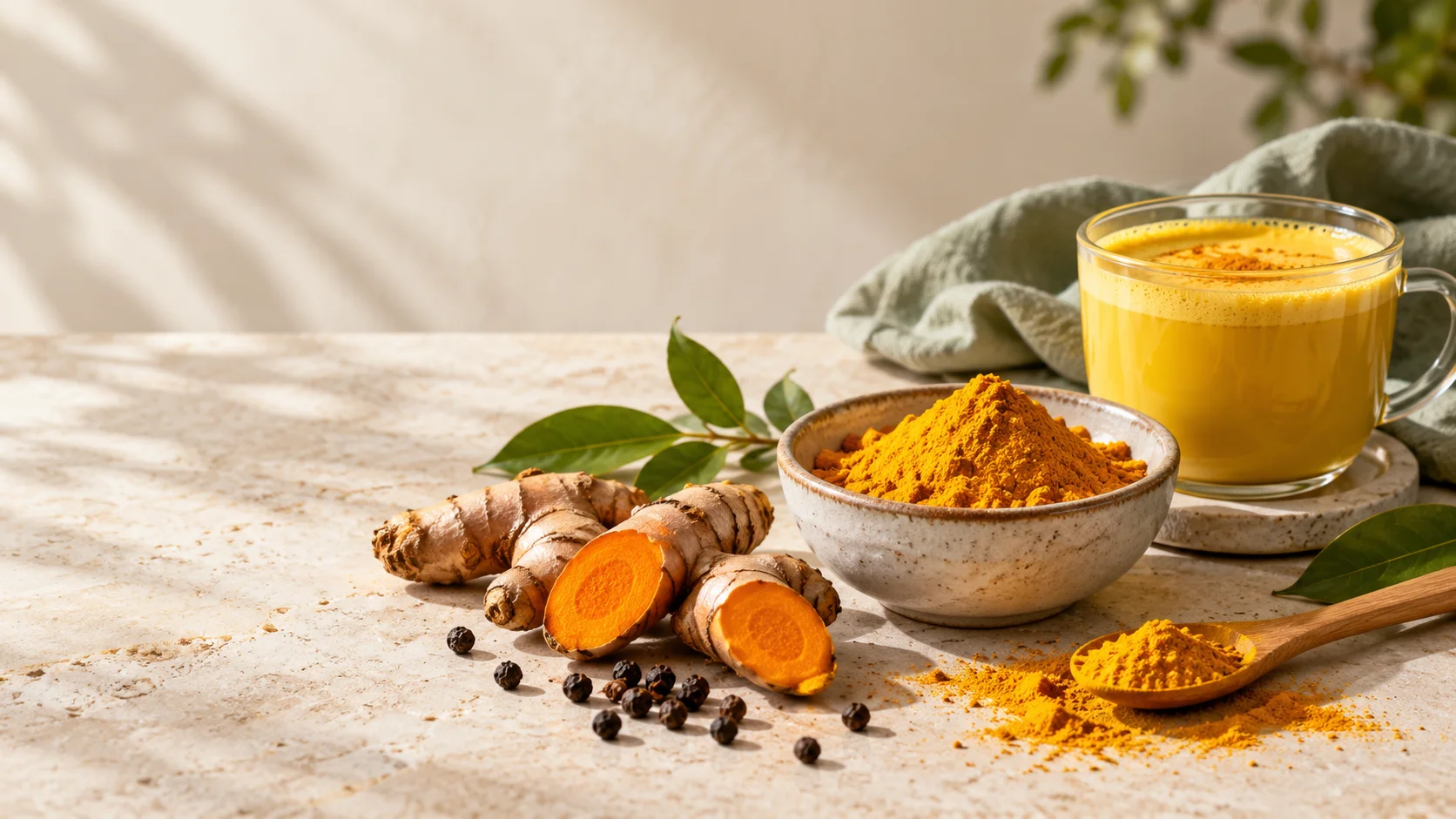
Can a pinch of turmeric transform your dinner? Mostly, it adds colour and flavour. Use turmeric, ginger, garlic or herbs to vary your recipes, without expecting a seasoning to treat inflammation.
As for turmeric, research does not allow firm conclusions about its effectiveness for the various health uses claimed. A kitchen spice and a concentrated extract are not the same thing. Some enhanced-absorption curcumin formulations have been linked to liver injury.[8]
Plain yoghurt, kefir and other fermented foods can also feature in your meals, depending on your taste and tolerance. Their benefits are being researched; on their own, they don’t guarantee lower inflammation.[2]
How do you use this list in your meals?
Imagine opening your cupboard tonight: a tin of chickpeas, some rice and frozen vegetables. You already have the basics of a simple meal.
Here are three combinations to try:
Which foods should you limit?
Is adding nuts to your breakfast enough if sugary drinks take up a big part of your day? Eating better also means rethinking some habits.
Do you need supplements?
Should a capsule go on your shopping list? This way of eating does not automatically call for a supplement. Whether a product is useful depends on your situation, its composition and the evidence behind it.
If you’d like to learn about the brand’s range, you can discover AISA Moleculum Capsules. This doesn’t mean they are necessary or suitable for everyone.
Sources
- NHS, “Eating a balanced diet”. nhs.uk
- Harvard T.H. Chan School of Public Health, The Nutrition Source, “Diet Review: Anti-Inflammatory Diet”. hsph.harvard.edu
- Koelman L. et al., “Effects of Dietary Patterns on Biomarkers of Inflammation and Immune Responses: A Systematic Review and Meta-Analysis of Randomized Controlled Trials”, Advances in Nutrition, 2021. PMID 34607347
- NHS, “5 A Day: what counts?”. nhs.uk
- Santé publique France (French national public health agency), Manger Bouger, “Eat more pulses”. mangerbouger.fr
- NHS, “Fish and shellfish”. nhs.uk
- Santé publique France, Manger Bouger, “Eat more unsalted nuts”. mangerbouger.fr
- NIH, NCCIH, “Turmeric: Usefulness and Safety”. nccih.nih.gov
- d’Alessio P.A., Ostan R., Bisson J.-F., Schulzke J.D., Ursini M.V., Béné M.C., “Oral administration of d-Limonene controls inflammation in rat colitis and displays anti-inflammatory properties as diet supplementation in humans”, Life Sciences 92 (2013) 1151–1156. doi:10.1016/j.lfs.2013.04.013
You might be interested in this product
Anti-inflammatory capsules
«Inside-out» dietary supplement supports the integrity of the intestinal barrier and a balanced microbiome, helping to manage stress. 2 to 4 capsules daily on an empty stomach. Content corresponds to a take for 2–3 weeks. European clinical study on 138 healthy patients aged 65–85, for 45 days.

TARIF
€
120.00
A European clinical study involving 138 healthy patients (ages 65–85).


FAQ
Everything you need to know before placing an order: simple and clear.
What is the most powerful anti-inflammatory food?
There is no reliable universal ranking that answers this for everyone. Research on eating patterns does not attribute their benefits to one ingredient. Focus on variety rather than large amounts of a single food.[3]
Are frozen and tinned foods OK?
Yes. Plain frozen vegetables, tinned beans and pulses and tinned fish can make meals easier. Check the ingredients and any added salt, sugar or sauces: the packaging alone doesn’t tell you how good a food is.[4, 6]
Can I follow this approach without eating fish?
Yes. Focus on a variety of plants, beans and pulses, whole grains, nuts and some oils. Plant and marine sources of omega-3 are not the same, though. If you cut out several food groups, a registered dietitian can help you meet your needs.[6]
Are coffee and dark chocolate essential?
No. You don’t need them to follow the principles on this list. If you enjoy them, their place depends on your habits and tolerance. A food you enjoy doesn’t need a health promise to earn its place.
Which foods help with joint pain?
The habits described here can support a balanced diet, but no list can point to a food that will reliably treat your joints. Persistent pain deserves a medical assessment. Keep taking any prescribed treatment and ask for tailored support.
Latest posts
Did you enjoy this latest article? If so, you might be interested in this selection.




Ready to slow down the aging process?
Sign up for our newsletter and join the thousands of people who follow us to regain energy, vitality, and well-being.

Your cart summary
Product Name
$0
$0
-
Thank you! Your submission has been received!
Oops! Something went wrong while submitting the form.
+
Success message won't be visible to user. Coupon title will be listed below if it's valid.
Coupon1
Coupon2
Success message won't be visible to user.
Error message won't be visible to user.